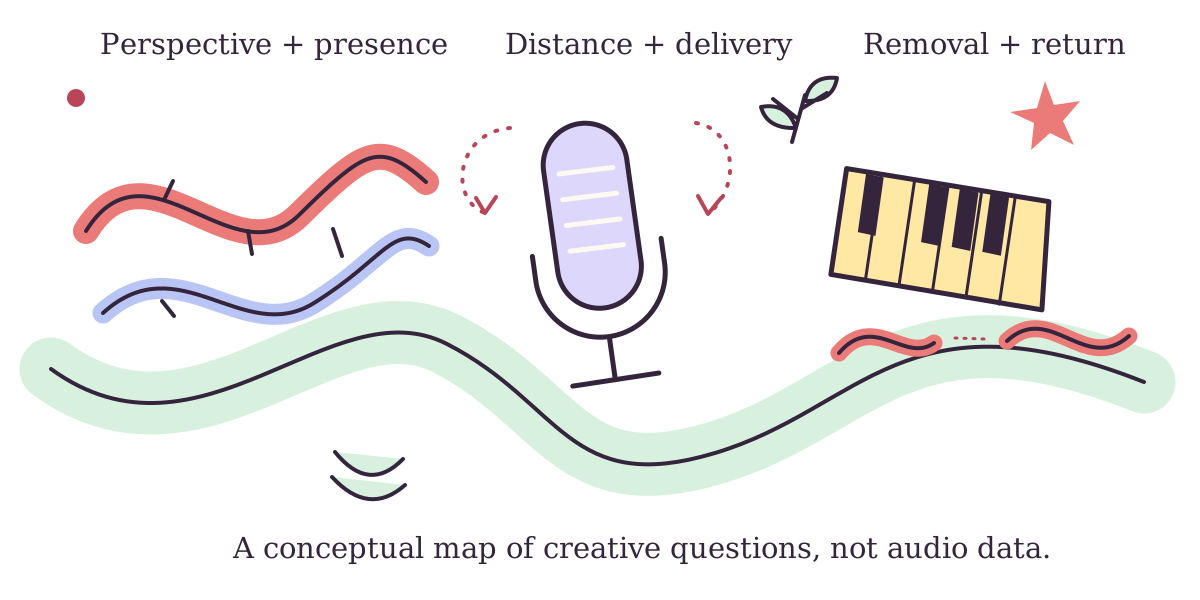
A voice can perform a song, carry a point of view and become part of its arrangement. Those are three different jobs. The published accounts of Billie Eilish and FINNEAS making “Everything I Wanted” offer a useful way to explore how they connect: a change in perspective, a second vocal presence and the space created when an instrument steps aside.
Our reading focuses on creative decisions, with sources beside the relevant claims. Content note: the Song Exploder interview discusses suicide explicitly. The discussion here stays with craft and mutual support; the source goes further. For other starting points, visit the Celebrity deep dives hub.
A narrator is a perspective, not just the singer’s name
In Song Exploder’s November 2020 transcript, FINNEAS explains making the chorus work as a conversation with a change of perspective. Eilish connects his vocal presence to the song’s account of their relationship. These are the collaborators’ descriptions of the choices, rather than a biographical meaning inferred from a credit line.
For analysis, separate who sings from whose perspective is being expressed. One performer can convey more than one position. A supporting voice can introduce another presence without taking over the main line. That gives you a more precise question than simply counting singers: what relationship does the arrangement invite you to follow?
A useful comparison is a narrated conversation on the page. One reader could speak both parts, two readers could alternate, or the second reader could quietly reinforce a line. The underlying exchange could remain recognizable while the feeling of presence changes. This comparison is our analytical tool, not a reconstruction of the recording session.
Closeness can be a performance choice
In Lily Moayeri’s January 2020 studio interview for Mix, FINNEAS describes handling a microphone so that he can move close for delicate singing and pull back for a larger note. The profile also places Eilish’s vocals for this single in his later Highland Park studio. That is a documented period practice and location, rather than a claim about every take.
Our proposed lens is to treat perceived closeness as something made, not a window that bypasses performance. Ask how the foreground voice relates to the rest of the sound. Does it seem surrounded, exposed, reinforced or interrupted? Those descriptions give a discussion something concrete without requiring you to guess the microphone model from the finished track.
It is also worth leaving room for several decisions at once. Delivery, recording distance, level and the other sounds around a voice are different variables. A published account can identify a particular choice; your response to the result belongs in the next sentence. Keeping those sentences separate makes it easier to explain why a detail interests you.
An arrangement can change by taking something away
Later in the Song Exploder transcript, FINNEAS describes removing and returning the piano to renew attention, while Eilish discusses vocal layers that become more apparent in isolation. Their account directs us toward absence and supporting detail, as well as the prominent melody.
Try a simple thought experiment unrelated to the song. Picture a room with a softly ticking clock. You might stop consciously attending to the tick, then notice the room differently when it ceases. Its return can feel like a new event even though the sound itself has not become louder. The useful comparison is attention, not a claim that every listener responds identically.
This gives you a listening question you can choose to test: when a familiar element disappears, what becomes easier to notice? You might attend to a voice, a rhythm, or a gap you had not previously described. Adding more material is only one way an arrangement can develop.
The collaboration has a point of view too
In The FADER’s February 2020 interview, FINNEAS describes serving an artist’s identity instead of imposing his own sonic signature. Discussing “Everything I Wanted,” he presents shared experience as central to it. The interview supplies his account of the working relationship, with its own questions and context.
Eilish’s January 2020 label announcement identifies her as the music video’s director and records her intention to emphasize mutual support. That gives the visual project a stated creative aim. It is a different piece of evidence from an isolated instrumental part or a production credit.
Read those accounts together and a useful question emerges: how can a work give a relationship a form, rather than merely announce that the relationship matters? You can consider the placement of voices, the balance between foreground and support, and how a repeated idea changes context. Our interest is in that connection between a creative aim and a series of choices.
Try a voice-and-space exercise
Imagine a completely different scene: one person worries about a difficult journey, and a friend offers to accompany them. There are no borrowed lyrics here. Consider how each arrangement below could change your attention before opening the response.
One voice relates both sides of the exchange
You can understand a conversation without hearing two distinct performers. Listen for how wording, delivery or a pause might indicate the change in perspective. The relevant question is whether you can follow the relationship, not whether the personnel list contains two lead singers.
A second voice supports part of the response
The support can make another presence perceptible without requiring equal time or volume. Ask what becomes different when an answer is reinforced. A backing part is an arranged contribution; its dramatic function deserves a description of its own.
A repeating instrument disappears during the reply
Removing the familiar sound could give the response more exposed space. Its return could reconnect that moment with the earlier passage. Compare the relationship between elements rather than assuming that every development must introduce a new sound.
Choose one of those questions for your own next listen, then return to the creators’ account and compare it with your observation. For the roles named in a recording, continue with our composition-and-recording credit explainer. For another documented creative process, explore the Dua Lipa and Koz route.