Taylor Swift, Jack Antonoff and Annie Clark are listed as songwriters on Olivia Rodrigo’s “deja vu,” alongside Rodrigo and Daniel Nigro. That is what the current Apple Music US credit entry says. The useful next step is to read the role attached to each name, then separate that current listing from accounts of the song’s creation.
A familiar name can pull attention away from a small but essential label. “Songwriter,” “Vocals” and “Producer” answer different questions. This case study follows those labels and a few dated sources, giving you a method to use when a credit list becomes a much larger story online.
Start with the particular recording and the particular role
For this check, the item is deja vu on the original SOUR album entry in Apple Music US. The credits were checked on . Identifying the item matters: a cover, remix, video or another release can have a different set of performance and production credits.
Under Composition & Lyrics, that entry labels all five names as Songwriter: Olivia Rodrigo, Daniel Nigro, Annie Clark, Taylor Swift and Jack Antonoff. Under Performing Artists, Rodrigo is separately credited for vocals and background vocals. Under Production & Engineering, Nigro is credited as producer and recording engineer.
Keep those categories attached to the names when explaining the list to someone else. “Swift has a songwriter credit on this entry” is a precise statement. Reading a songwriting label as a vocal label changes the statement. Reading five names as an account of five people writing together in one room adds a description of a session that the list itself does not provide.
The same person can appear in several columns
The Apple Music US entry for Taylor Swift’s Cruel Summer offers a useful comparison. Its songwriting list names Swift, Antonoff and Clark. Swift also has separate vocal and producer credits; Antonoff has separate performance and production roles; Clark has a guitar credit.
Those repeated names do not make the categories interchangeable. They show why it is worth reading beyond the most prominent artist heading. A person can be credited for several kinds of work on one recording, while a reference to that person on another entry can identify a different role.
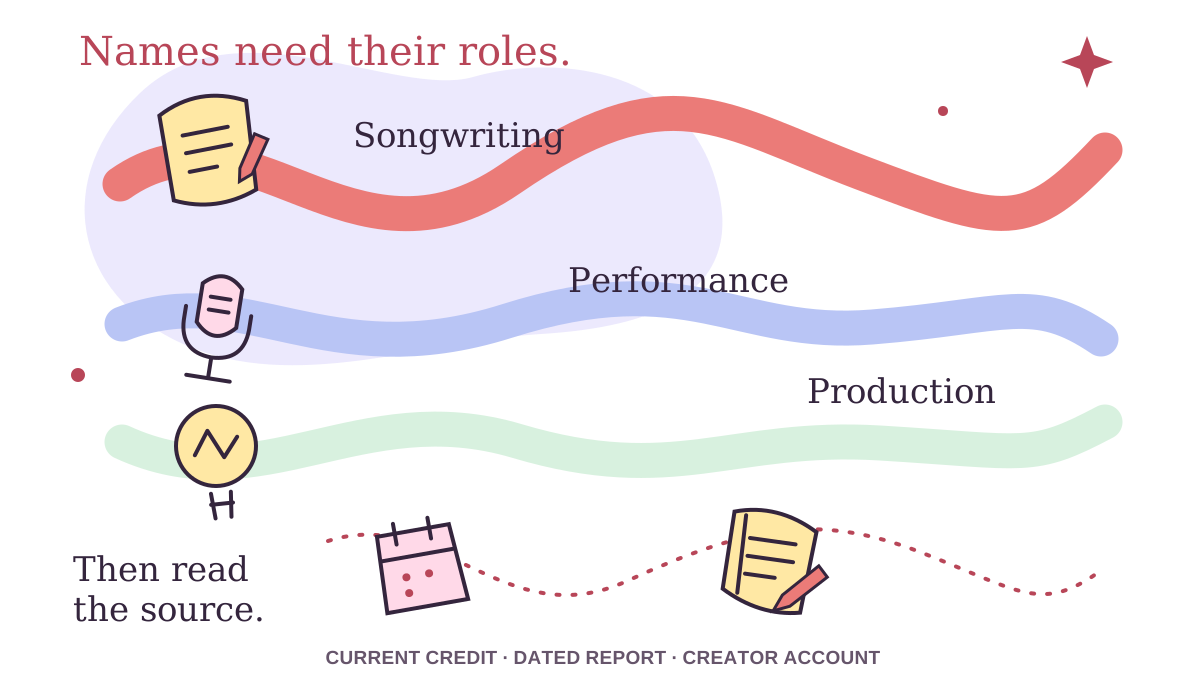
The ribbons in the illustration are a way to keep that reading organised. One follows the writing category, another follows performance, and a third follows production. Their width and length have no numerical meaning. A separate trail holds dated source documents, because a credit category and an account of an event are different forms of evidence.
A release date, a report date and a checking date
On 1 April 2021, Universal Music Canada announced deja vu’s release and identified Dan Nigro as producer and co-writer. That supplies a contemporaneous collaborator reference. The announcement’s narrative is not presented as an exhaustive songwriter roster, so it should not be treated as one.
A 9 July 2021 Pitchfork report described the additions of Swift, Antonoff and Clark to the songwriting credits, citing Rolling Stone. It also said the precise prompt for those additions was unclear. That is attributed contemporary reporting; its publication date does not establish the exact time a service’s metadata changed.
In Angie Martoccio’s published 2023 Rolling Stone interview, Rodrigo described limited personal involvement in the handling of SOUR co-writes and said it was more team-level work. That answer concerned the album’s co-write questions broadly. It is her dated account, rather than a detailed history of every credit on this one track.
Our 2 November 2026 checking date answers another question again: when this article inspected the current listing. It does not move the song’s release into 2026 or turn today’s credits into a preserved snapshot of the original release day. Keeping the dates separate makes a short explanation more accurate.
What can this source support?
Read each statement, then open the explanation. This is an exercise in matching a claim to a source; it does not ask you to guess what happened beyond the documents.
“Swift is credited as a songwriter on this deja vu entry.”
Supported by the current Apple Music credit category checked here. Keep the recording and the checking date attached. The role label is the evidence; the fame of the name is not a substitute for it.
“Everyone in the songwriting list performed on this recording.”
The songwriting list does not establish that statement. Check the separate performance roles for the particular recording. On the same page, Rodrigo’s vocal role and Nigro’s production role demonstrate why the category needs to travel with the name.
“The page’s April 2021 release date tells us when each credit was added.”
It does not supply a revision history. A release date identifies the item’s release; the July report describes what was reported at that later date. Neither should silently become an exact timestamp for every metadata update.
“Five songwriter names tell us who was in the studio together.”
A personnel list is not a session diary. A session account needs an appropriate source of its own. Keep the confirmed role and the unestablished scene separate, rather than illustrating an imagined gathering as a real event.
Take a better sentence into the next conversation
A useful credit note has four parts: the work, the version, the role and the source date. If you add a historical explanation, identify where that account comes from. When a source leaves a question open, retain that gap in your own sentence. Precision can make a pop conversation more interesting without making it less curious.
For a different use of the composition-and-recording distinction, continue with Record of the Year versus Song of the Year. For more published creator accounts and source-reading routes, explore the celebrity deep-dive hub.