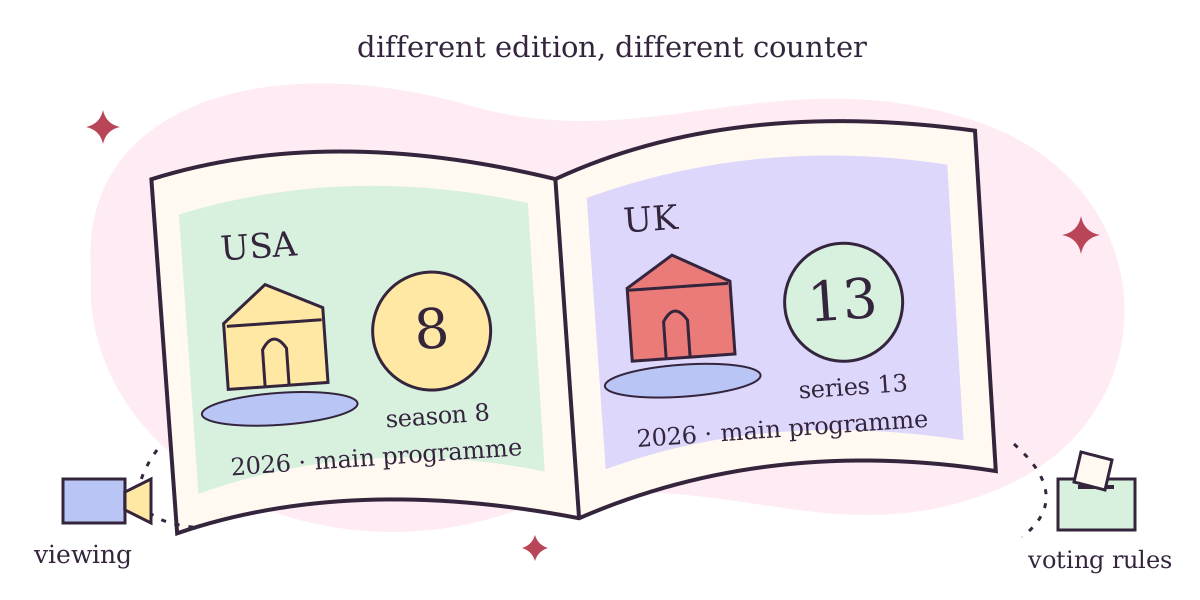
Love Island USA and the UK Love Island are separate national editions with their own season numbering. For a concrete 2026 comparison, Peacock identifies USA season eight while ITV identifies UK series thirteen. “Season eight” on its own is therefore an incomplete address. Add the country and year before choosing an episode or joining a conversation about it.
The useful question is which programme you mean, rather than which nation has the “best” contestants. This guide gives you a small edition passport: the country label, numbered run, year and programme type. It uses format premises and dated broadcaster information, without winner names, eliminations or relationship outcomes. Linked episode pages can reveal those details.
Give your watch a complete address
Compare these two documented examples. The numbers are counters within different editions; they do not identify matching installments in a single worldwide sequence.
| Edition | Selected 2026 run | Official identity clues |
|---|---|---|
| Love Island USA | Season 8 | Peacock’s programme page identifies the USA edition and its Fijian setting. |
| Love Island UK | Series 13 | ITV’s press pack identifies the UK run, ITV2/ITVX and its Mallorcan setting. |
Those clues come from Peacock’s USA programme record and ITV’s May 2026 UK introduction. They are examples for identifying a run, not a promise that every service carries it. A provider’s available-season count also describes its listing; it is not necessarily the total number of seasons the edition has produced.
Write the full address in a private viewing note: “USA / season 8 / 2026 / main programme,” for example. If a friend sends a clip, ask for those details before opening a cast page. A correct country label can save you from researching the wrong group and discovering results you did not want to know.
Recognizable format, specific instructions
Both editions use the language of couples, new arrivals and changing connections. Peacock’s USA format guide describes recouplings and viewer involvement; ITV’s UK introduction describes a new group forming connections through its own run. That makes the family resemblance easy to recognize without making every mechanism identical.
A useful watching habit is to separate three events: a couple changes, someone leaves, and an audience is asked a question. They can be related, but the instructions for the particular event tell you how. Listen for who is deciding and what the decision concerns. The UK series-thirteen terms, for example, allow voting and elimination formats to vary. Treat that as evidence about the named UK run, rather than a universal rule for the franchise.
The programme label matters too
After identifying the edition, check whether you have opened the main show, a companion discussion programme, a reunion or a returning-participant branch. Those labels tell you what sort of viewing experience you are choosing. A discussion programme may assume you already know what happened in the main episodes, so it can be a poor spoiler-free introduction.
A dated Canadian example makes the distinction concrete: Bell Media’s June 2026 Crave announcement lists USA season eight and Love Island: Aftersun separately. That establishes what Bell announced for that period. It does not turn Aftersun into another national edition, establish a November subscription offer, or grant voting eligibility to everyone able to watch in Canada.
Watching and voting are different permissions
Peacock’s programme information describes USA voting eligibility in U.S.-resident terms, and its dated season-eight voting guide describes U.S. phone verification and specific voting windows. ITV’s 2026 UK conditions identify a different eligible territory: the UK, Isle of Man and Channel Islands. These are separate sets of instructions for separate productions.
Old search results can add a third source of confusion. CBS’s June 2020 terms expressly included the United States and Canada for its historical programme. That document is not evidence that a Canadian viewer could participate in Peacock’s 2026 votes. Check the edition, broadcaster, date and event together. An archive episode also does not reopen the window it describes.
Find your next step
I know only a season number
Find the country label and year on the actual programme listing. Compare the first episode’s identity without reading its outcome. If the number belongs to a different edition, start a separate viewing note instead of trying to force the two runs into one sequence.
I want a complete archive watch
Choose one identified run and begin at its first main episode. Save companion discussions, reunion descriptions and participant biographies for later if you want to preserve outcomes. A completed archive is a viewing choice, not an invitation to participate in an old vote.
I am watching from Canada
Use the Canadian provider’s own current listing for access and episode identity. Keep that viewing information separate from the production’s voting conditions. The dated Crave example above helps identify the USA programme; it does not guarantee today’s catalogue or transfer another country’s participation rules.
Continue into our Love Island UK hub for a clearly scoped UK starting route and All Stars context. For a different kind of catalogue confusion, use the Netflix missing-title checklist. Clear labels leave more room for enjoying the show and less room for accidentally watching the wrong villa.