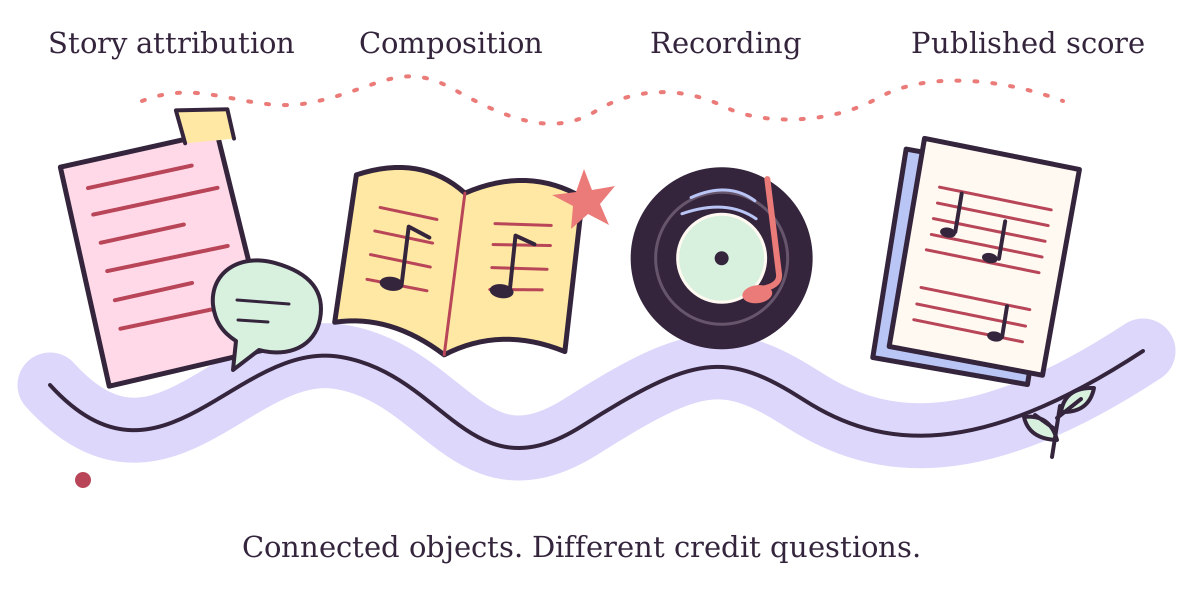
Glee mixes cover versions with original songs. A cast recording tells you which version you have found; it does not, by itself, identify everyone who wrote the composition. To follow the credit, separate four things: what happens inside the story, who wrote the song, who made a particular recording and what a published arrangement credits.
This guide reveals the songwriting premise of season two’s “Original Song” and names a song from the finale, without discussing either outcome. The Glee hub has a first-watch route if those episode references are ahead of you.
“The characters wrote it” answers a story question
Apple’s US catalogue identifies “Original Song” as season two, episode sixteen, dated March 15, 2011. Its premise has the club writing and performing its own songs for regionals. That establishes what the fictional group is trying to do.
A character’s creative achievement and an actor’s real credit belong to different records. A scene about writing a song can be written by a television writer, performed by an actor and built around music by other writers. You can appreciate the character’s decision while still looking beyond the story for the people who made the number possible.
The same distinction helps when a clip circulates without its episode. Ask whether the label names a character, an actor, a recording artist or a writer. Those may connect to the same person in some cases, but the connection needs evidence rather than a familiar face.
The label’s original tracks sit beside covers
In its February 22, 2011 announcement, Columbia introduced “Loser Like Me” and “Get It Right” as original tracks on Glee: The Music, Volume 5. It named Max Martin as a co-writer of “Loser Like Me” and Lea Michele as the voice of “Get It Right.” The same release described cast versions of existing songs including Katy Perry’s “Firework.”
Notice the different verbs: someone can write a song, sing it or release a version. One name in a promotional announcement may establish a particular contribution without supplying a complete credit list. Preserve the role attached to the name rather than turning a short announcement into a claim that one person did everything.
For a useful search, keep the title beside the version and release. A track title alone can lead you to another artist’s recording, a later cast version or a choir score. Identifying the object first makes the next credit question much easier.
A cover has new creative choices and existing composition credits
A concrete example appears on Hal Leonard’s “Rolling in the Deep” choral page. It names Paul Epworth and Adele Adkins as composers, Peer Astrom and Adam Anders as arrangers, and Mark Brymer as editor. The publisher connects the song with Glee’s “Prom Queen” episode.
These are credits on that published choral product. They distinguish functions instead of making “arranged by” another way of saying “composed by.” They also do not constitute a complete list of the personnel behind the television recording. A score, a soundtrack and an episode can be related without being interchangeable sources for every role.
This makes room for a more interesting discussion of a cover. You can ask how the version treats tempo, texture, lead and supporting voices, or the moment a character enters. Describe a choice you can identify and keep its authorship tied to the credit you can verify. Admiring a new performance need not erase the songwriters.
A performer can also be a songwriter
The Television Academy’s 2015 record lists “This Time,” from “Dreams Come True,” as an Outstanding Original Music and Lyrics nominee, with Darren Criss credited for music and lyrics. The Academy’s Criss profile separately identifies him as Blaine Anderson’s actor. Here, the connection between a cast member and a writing credit is documented.
Read the status as carefully as the name: the entry is a nomination. A credit map is most useful when it retains those small distinctions. It can show that one person holds several roles without suggesting that all performers write their songs, or that every nominated work won its category.
The studio work is another part of the story
In Michael Gallant’s June 2011 producer interview, Adam Anders describes arrangements, demos and cast vocal sessions, followed by exchanges with Peer Astrom for programming and mixing. His account presents an intensive production process behind the musical numbers.
That is a helpful alternative to treating the cast recording as an untouched document of a fictional school performance. When analyzing a number, distinguish the sound recording from the way the episode stages it. The first gives you vocal and instrumental relationships; the second also places bodies, reactions and story context around them.
Try reading the credit without skipping a layer
Choose the source you would consult before opening each answer.
An episode says the students wrote their own songs. Does that identify the real songwriter?
It identifies an event inside the fiction. Find the song’s real composition credit or a source naming the writer’s contribution. An actor’s performance and the character’s authorship do not settle that question on their own.
A choir score names arrangers. Have the original composition credits disappeared?
No. Read the fields separately, as on the Hal Leonard example. Then identify which arrangement the page describes. Keep that score’s editor and arrangers attached to the published product instead of guessing the full recording team.
An award page names a cast member beside an original song. What else should you read?
The role, work, year and status. The 2015 “This Time” entry identifies a real songwriting credit and a nomination. It answers a more precise question than a general statement that the performer “has an Emmy.”
Follow one number through those layers and you have a stronger conversation than “original or cover?” alone. Return to the Glee music and rewatch routes, or continue with the different credit questions behind Record and Song of the Year.