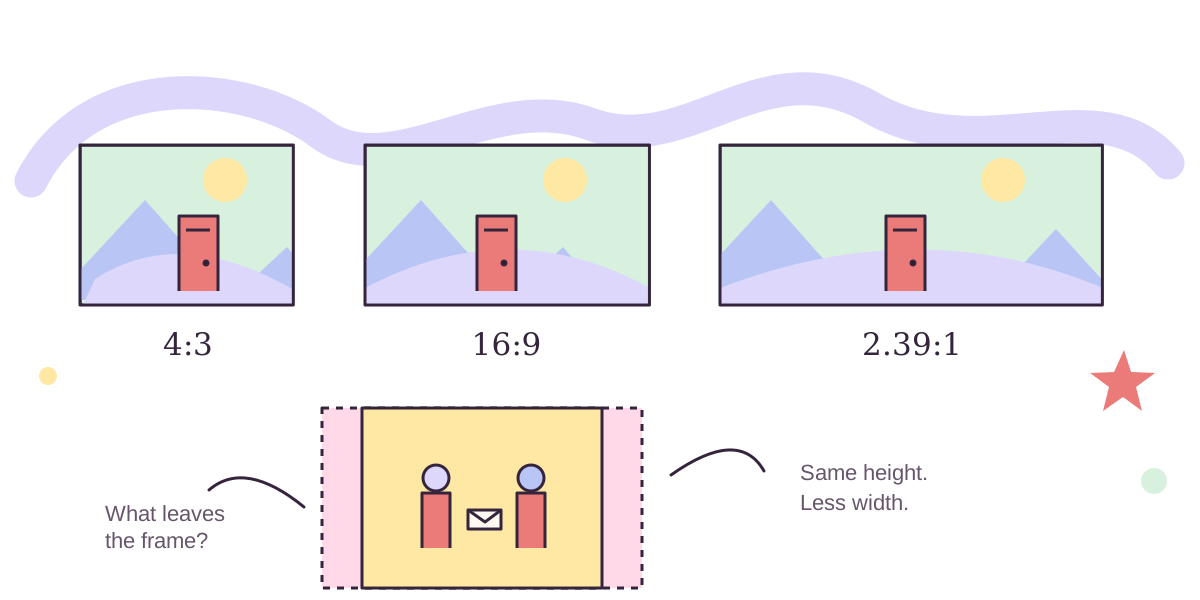
An aspect ratio describes an image’s width in relation to its height. It tells you the shape of the picture, not how good the film is. A nearly square frame can hold a whole world; a wide one can make a room feel cramped. The useful question is what the filmmaker puts inside that shape—and what a different presentation might cut away.
This is a spoiler-free guide to reading the frame. The technical definitions come from the primary sources linked below; the viewing exercises and interpretation are our own.
Two numbers, one shape
In 4:3, four units of width go with three units of height. Divide four by three and you get about 1.33, so 4:3 and 1.33:1 describe approximately the same shape. In 16:9, the width is about 1.78 times the height. A 2.39:1 image is wider again: its width is 2.39 times its height.
Those numbers do not tell you the pixel count. A 1920 × 1080 image and a 3840 × 2160 image share a 16:9 shape even though their dimensions differ. ARRI’s delivery guide lists HD and UHD examples alongside the commonly used digital-cinema Flat and Scope formats. Keep shape and resolution as separate questions: “How wide is the frame?” and “How many pixels describe it?”
Think of the frame as a set of relationships
Try this imaginary shot: two friends sit at opposite ends of a bench, with an unopened letter between them. A wider composition could keep all three elements visible together. The empty bench might become part of the tension. A tighter composition could make you wait for a cut before learning who is at the other end. Neither choice automatically improves the scene. They make different information available at the same moment.
This is why we resist a simple “wide equals epic, narrow equals intimate” rule. Distance, lens choice, movement, sound and performance all matter too. A wide frame can isolate a tiny person in a room; a taller composition can make a doorway or staircase feel enormous. Treat the ratio as a starting condition for composition, not a personality test for the movie.
Black bars can be doing their job
When an image and a display have different shapes, showing the whole image can leave unused space. Bars above and below are called letterboxing; bars at the sides are pillarboxing. Apple’s technical explanation also notes that bars may already be encoded into a video. Seeing bars alone does not prove that a player is malfunctioning.
A helpful first response is to look at the image itself. Are faces stretched? Are the opening titles cut off? Has a “zoom” setting enlarged the centre? If everything looks proportionate, filling every part of the screen may be a less faithful goal than preserving the picture you were given. Our recommendation is to begin with a fit/original-aspect presentation, then consult the release or device guidance if something still looks wrong.
Why can a cinema file have bars inside it?
A delivery container and the picture inside it are different things. ISDCF’s projection guidance explains that a narrower image can sit inside a wider Flat package with pillars, while other shapes may use letterboxing. The package’s dimensions do not, by themselves, reveal the intended picture shape.
“Fill the screen” makes a trade
Imagine a 1920 × 1080 rectangle. To turn it into a centred 4:3 rectangle while keeping the same height, you would retain 1440 × 1080 and remove 240 pixels from each side. That is 480 of the original 1920 horizontal pixels: a quarter of the width. This is our deliberately simple arithmetic example, not a claim about every cropped release.
Now put the bench, the friends and the letter back into that rectangle. What survives depends on where they sit. Cropping could remove a listener’s reaction or a detail near the edge. Stretching the original picture to fit would instead change its proportions. An alternate version can also involve a deliberately different framing decision. Before calling one presentation “more complete,” check which version it is and what evidence its publisher provides.
A small experiment for your next film
Choose a quiet shot and notice the edges before the centre. What is allowed to stay beside the main action? Where is the empty space? Does an entrance begin at the side of the frame or deep in the background? You do not need to pause every scene or identify the ratio from memory. The point is to notice how the picture makes room for the story.
We find frame shape most interesting when it changes the questions we ask, rather than becoming a scorecard. A new display or edition should help us see the composition, not quietly substitute another one. If you are comparing releases, continue with what a film restoration actually changes. For another way into a film, return to the Film desk.