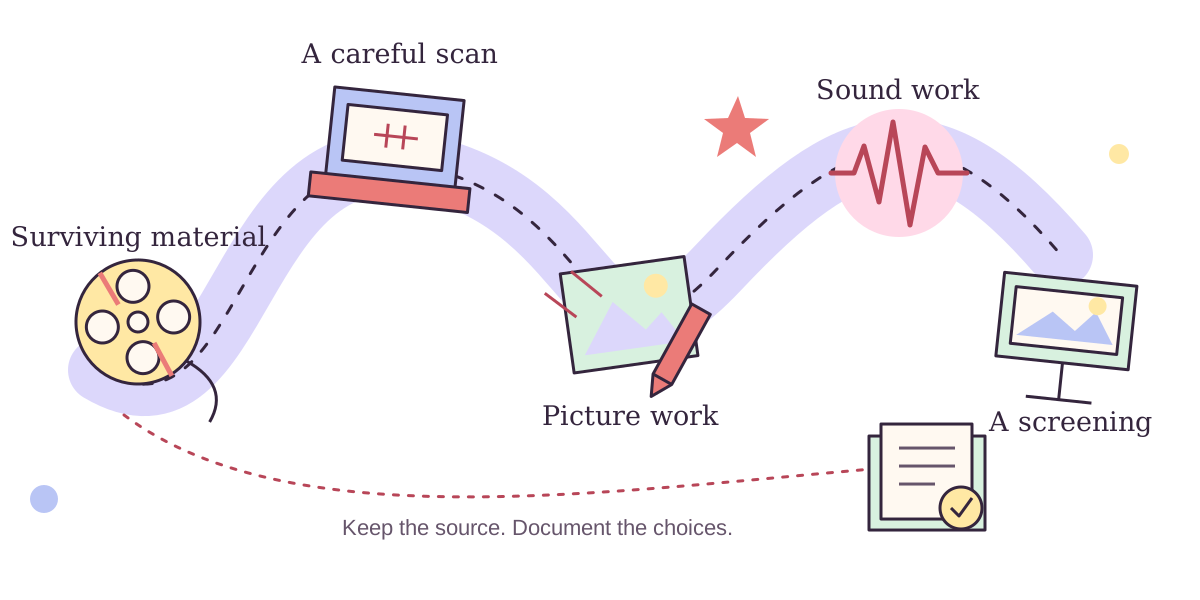
A film restoration is a researched intervention in surviving materials, not simply a resolution upgrade. Scanning, repairing damage, finding colour references and working on sound can all be part of the journey. To understand a particular release, ask what material the team started with, which version it represents and how its choices are documented.
This guide draws on archival guidance and a named restoration case study. It does not review an unseen disc, promise that one edition is definitive, or assume that every project follows an identical workflow. Our central argument is simple: a useful restoration credit should open a conversation about the work behind the image.
Start with the surviving evidence
“Original negative” sounds like an easy answer to the question of source quality. The archive picture is more complicated. FIAF’s technical guidance describes how camera elements and exhibition prints preserve different information; a finished print may retain characteristics absent from production materials. Source selection therefore involves historical context as well as image quality.
For a viewer, that changes the question from “Did they find the best reel?” to “Best for reconstructing what?” A project might be trying to reproduce a particular release version or recover material whose ideal source no longer survives. We should want the restoration notes to explain that aim. A confident adjective on the packaging tells us less than a specific account of the evidence.
The scanner is a beginning
The BFI’s account of the 2023 restoration of Peeping Tom (1960) makes the physical work tangible. Its original Eastmancolor negative needed repairs to joins and perforations before scanning. The project used a 6K scan, then downsampled to 4K for restoration work. Those are the details of that project, not a universal recipe.
Our takeaway is that the large number on a release cannot describe all the decisions behind it. A scan does not explain how a damaged element was prepared or what happened afterwards. When a release advertises “4K,” look for the accompanying notes before inferring the whole production chain. The label is a useful piece of information; it is not the entire restoration report.
Repair has a boundary
It is tempting to imagine restoration as a cleaning contest: keep removing marks until nothing distracts you. But an image is also a record of its production. FIAF distinguishes later damage from original photographic and production characteristics. In its 2025 Code of Ethics, the federation calls for respect for original materials, documented interventions and reversibility; it also distinguishes restoration from deliberately making a new version.
For us, that makes “looks newly shot” a weak test. A surface can become smoother while a film becomes less specific. This does not mean every visible speck is sacred, or that a viewer can diagnose a restoration from one compressed screenshot. It means the goal needs to be stated. Are we looking at an effort to reduce deterioration, or a newly revised presentation? Both labels deserve clarity.
Colour is a research question too
Restoring colour is not necessarily a matter of pushing a saturation slider until the image feels lively. FIAF recommends working from reference materials and historical context, while recognising that even period prints can vary. A reference makes a decision accountable; it does not turn every judgement into an automatic calculation.
When two editions differ, we would first ask whether they draw on different evidence, target different presentations or represent different versions. Calling the brighter image “correct” by default skips those questions. A fair comparison identifies the releases and the conditions being compared. Side-by-side images can begin a discussion, but they cannot supply missing provenance on their own.
Do not leave the soundtrack behind
The Peeping Tom case study describes separate sound restoration by Helen Miles at Molinare, working with the BFI team. Optical tracks held by the BFI and StudioCanal were brought together for the work. The interviews also discuss preserving expressive contrasts in the soundtrack rather than simply softening everything a modern listener might find startling.
That example suggests another viewing habit: listen for the shape of a scene as well as its clarity. A sudden sound can be part of a dramatic design. We should not assume that making every passage equally comfortable is the same as recovering the film. Sound notes, like picture notes, help distinguish repair from a revised creative choice.
Is a restored version necessarily a different cut?
No. Do not infer an editorial change from a restoration label alone. Check the stated version and the documented changes. FIAF’s guidance treats the integrity of different release versions as something to preserve, not an invitation to assemble an unexplained hybrid.
What to look for in a restoration note
We recommend looking for five things: the credited archive or team; the source materials; the version being presented; the work done to picture and sound; and any limits or reconstruction decisions. These questions are more useful than treating “restored” as a five-star rating. Absence of detail does not establish that a release is bad, but it does limit what we can responsibly say about it.
The pleasure of a restored film need not disappear into technical homework. A few precise credits can bring the people and choices behind a screening into focus. Follow that curiosity into the shape of the frame, or return to the Film desk to keep exploring how movies reach us.