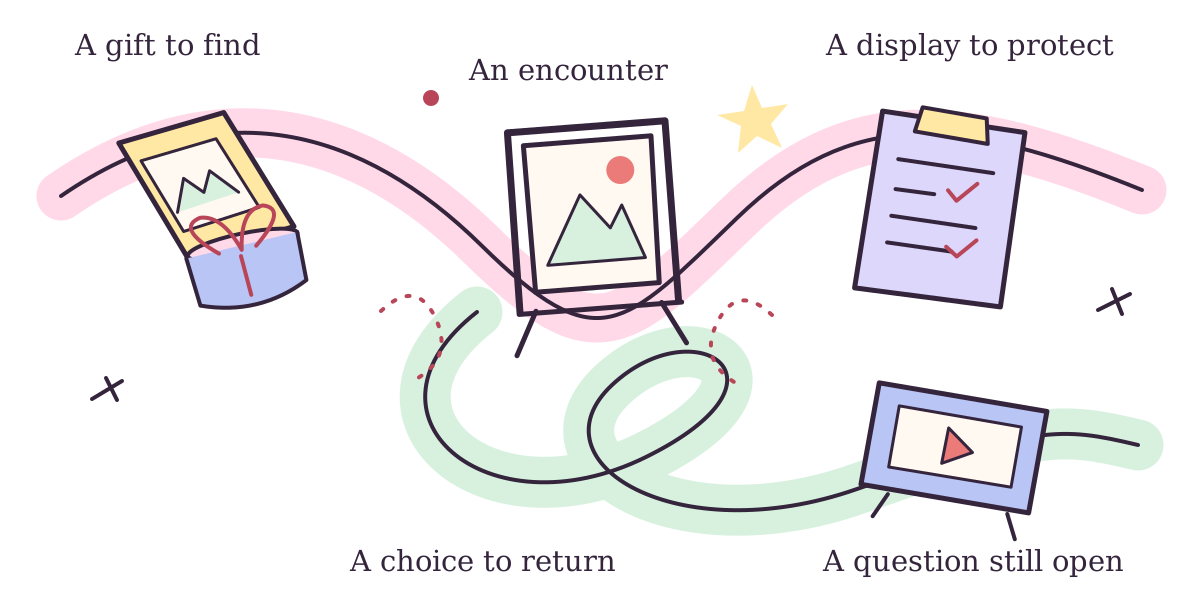
A meet-cute is an encounter that makes a potential romantic relationship feel like a story worth following. The useful part is not necessarily a cute accident. It is the way two people’s separate aims become entangled, revealing a reason for interest and a reason the relationship might be complicated.
This guide discusses an early setup from Bluebeard’s Eighth Wife and the broad premises behind two writers’ projects, without revealing endings. Our poster-sale exercise is completely invented. If you want a film starting point after exploring the mechanism, return to the Romcoms hub.
Give both people a life before the collision
Imagine a neighborhood cinema selling its old posters. Jules wants a particular poster as a gift and must leave town before the sale opens. Morgan volunteers at the cinema and needs to keep the display complete until the opening. They are now pursuing different immediate goals through the same object. Neither entered the room to become someone’s love interest.
The situation gives them something to do together: negotiate, find an alternative or disagree about an exception. Their behavior can reveal how they treat another person’s priorities. If Jules simply spills a drink and Morgan smiles, we have an incident. If the interruption exposes competing needs and changes a decision, we have material the next scene can use.
Different aims do not always mean hostility. They can fit together unexpectedly. The point is that each person brings an active desire into the encounter, rather than waiting to be selected by the other.
The joke can reveal a fit, not just a clash
In her BFI discussion, screenwriter Tess Morris describes the opening encounter in Bluebeard’s Eighth Wife (1938): one shopper wants only the top of a pajama set; another offers to take the bottom. The unusual transaction brings the two together.
Our reading of that setup is that a small practical problem can reveal compatibility. Their immediate wishes are complementary, even as the purchase disrupts a normal shopping routine. A meet-cute need not manufacture an argument to generate energy. A shared solution can be interesting if it suggests these people recognize possibilities others miss.
Take that question back to the poster sale: what might Morgan notice about Jules’s gift that changes the negotiation? What could Jules do that respects Morgan’s responsibility rather than merely charming a way around it? Attraction becomes more specific when it attaches to a choice.
An encounter needs a future tense
In BAFTA’s process interview, Morris recalls being mistaken for somebody else under Waterloo station’s clock, an encounter that prompted the idea for Man Up. She also argues for a larger question beneath the romantic comedy. That is a useful separation: the event that sparks an idea and the question that sustains a whole film need not be the same size.
For our invented pair, resolving the sale dispute may finish the anecdote. To begin a relationship story, give them a further choice. Perhaps they discover they are scheduled to co-host a screening series. Now Jules’s improvisation and Morgan’s careful planning can keep interacting. Returning is purposeful, and neither person has to remain trapped in the original misunderstanding.
An obstacle should also be something the story can examine. A misplaced telephone number is a logistical problem. Disagreeing about what reliability means can influence repeated decisions. One can support the other, but a single explanation may fix the first while leaving the second unresolved.
The first spark need not be the first hello
Discussing Shadowlands in his BAFTA/BFI screenwriting lecture, William Nicholson describes the meet-cute as the point when a romantic possibility becomes apparent, which may differ from the characters’ literal first meeting. That distinction makes room for stories about acquaintances whose relationship changes.
For analysis, ask what becomes newly possible. Has someone been seen outside a familiar role? Has an ordinary conversation disclosed an unexpected value? Repeating biographical introductions is less revealing than identifying what this particular exchange changes. This is our working lens, not a mandatory beat sheet every romance must obey.
Try three versions of the poster sale
Keep the same people, setting and object. Before opening each version, decide what you think it could carry beyond one scene.
A funny accident, then nothing changes
Jules knocks over an empty poster tube. Morgan catches it, they laugh and leave separately. The moment can be charming, but it has not yet given either person a new aim. Add a consequential choice if you want the encounter to launch the relationship rather than decorate the day.
One person wins; the other becomes an accessory
Morgan abandons every responsibility because Jules is attractive. Ask what Morgan wants besides approval. Giving Morgan a boundary or an alternative proposal can make the exchange reciprocal and reveal what Jules does when charm alone does not solve a problem.
A shared solution exposes a future disagreement
They arrange a way to reserve the gift without dismantling the display, then discuss their upcoming screening. Jules proposes a last-minute program change; Morgan needs advance notice. The encounter has shown cooperation while leaving a meaningful question about how they might work together.
Follow the question past the introduction
On Working Title’s Notting Hill page, writer Richard Curtis describes imagining how friends might behave if he brought a hugely famous person to dinner. That social question reaches beyond the simple novelty of a bookshop owner meeting an actress. The premise creates situations in which different worlds must share ordinary space.
For your next romcom, track three things: what each person wanted before meeting, the choice that made the encounter revealing, and the question still open afterward. Then look for a later scene that changes your answer. For another lens, explore how framing makes room for a conversation, or choose a route through banter, social worlds and complicated messages.