Star WarsA galaxy of stories. Your own way in.
The episode numbers and release dates tell different stories. Choose a route that fits the kind of discovery you want.
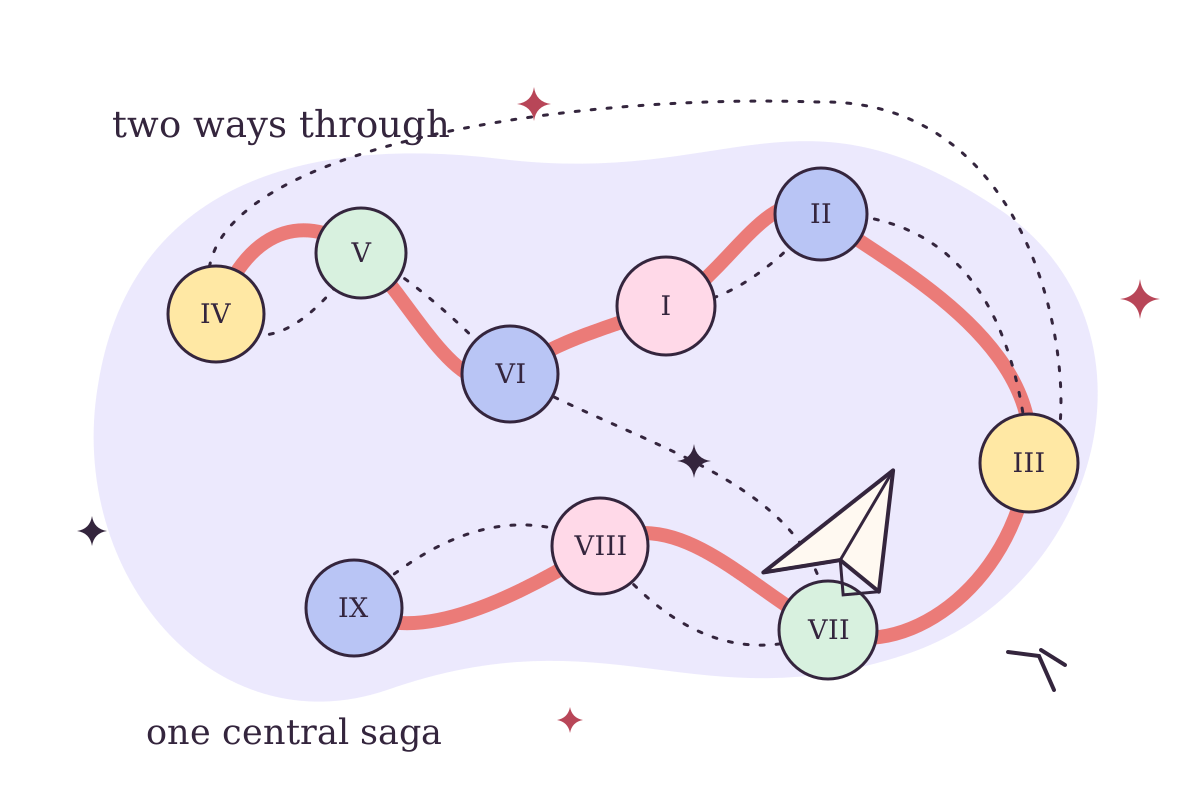
For a newcomer, our recommendation is to begin with A New Hope, then The Empire Strikes Back and Return of the Jedi. That is the original trilogy’s release sequence. The film now labelled Episode IV arrived before Episodes I–III, so the numeral is not an instruction to find three missing films before pressing play.
This hub provides a bounded nine-film Skywalker-saga map and a few clearly named branches. It is not an exhaustive list of every Star Wars release. The official viewing guide includes additional films, live-action series, animation and other formats; its catalogue continues beyond the central episode sequence. A short first-watch route can be useful without pretending those other stories do not exist.
The route picker lets you compare saga release order with numbered story order, or choose a deliberate small sample. These recommendations preserve different experiences. Release order follows how the central film sequence reached audiences. Numbered order follows the broad episode sequence inside the story. Neither arrangement turns every side adventure into required preparation.
Find your way in.
Pick the question you came with. These are editorial routes, with the choices and omissions explained.
Saga release order
Our recommended central-film first watch: IV–VI, then I–III, then VII–IX.
IV: A New Hope → V: The Empire Strikes Back → VI: Return of the Jedi
Watch the original trilogy in that order. The three films were released in 1977, 1980 and 1983; the story’s episode labels are a different kind of numbering.
Official original-trilogy release yearsI: The Phantom Menace → II: Attack of the Clones → III: Revenge of the Sith
Then follow the prequel trilogy. This changes the historical perspective after you have met the original trilogy’s world.
Official film entries and episode labelsVII: The Force Awakens → VIII: The Last Jedi → IX: The Rise of Skywalker
Finish with the sequel trilogy. This route filters the release record to the nine numbered saga films; it intentionally leaves intervening side releases for later.
Official release-order record
Numbered saga order
A broad story-sequence alternative for the same nine films: I through IX.
Episodes I → II → III
Begin with The Phantom Menace, Attack of the Clones and Revenge of the Sith. This is a story-order choice, rather than our default newcomer recommendation.
Episodes IV → V → VI
Continue with A New Hope, The Empire Strikes Back and Return of the Jedi. Earlier-made films arrive later in this viewing experience.
Episodes VII → VIII → IX
Finish with The Force Awakens, The Last Jedi and The Rise of Skywalker. This is the episode sequence only: it does not interleave every series, short, prequel or side film.
Disney’s Skywalker-saga chronological guide
A smaller first commitment
Try a particular storytelling flavour without promising a complete galaxy in one sitting.
One film: A New Hope
Our simplest sample asks one evening of you. Decide afterward whether you want the rest of the original trilogy before researching distant eras.
One branch: choose a format on purpose
The official series catalogue separates series from films. If you are drawn to animation or a live-action show, read its own premise and spoiler boundary rather than assuming every series has the same entry requirements.
Official series catalogueOne question: what counts as this timeline?
Before opening a giant list, check its scope. A numbered-film route, all-screen chronology and a books-and-comics route are different projects.
The best route tells you what it leaves out
A watch-order list is an editorial object. Someone chooses its boundary, resolves its edge cases and decides how much context a beginner needs. A nine-film sequence is easy to understand because its scope is explicit. Calling the same sequence “all Star Wars” would hide the existence of side films and television. A small, honest map is more useful than an enormous list with an uncertain boundary.
For this first watch, we recommend staying with one trilogy before taking a detour. That lets its story establish a rhythm and gives you a meaningful stopping point. If you would rather follow the episode numbers from I onward, use the numbered route and accept that it organizes discovery differently. We do not explain the later revelations here in order to argue for our preference.
When a friend suggests an elaborate alternative, ask what it optimizes: surprise, fictional chronology, a favourite character, or time available this week. The answer may make it a great rewatch experiment. It may also show why it is an awkward first recommendation for someone who just wants a starting film. A route can have a purpose without becoming the only legitimate way to watch.
Compare official release and chronological listsThe galaxy keeps going beyond the episode numbers
Rogue One and Solo are film branches outside the numbered nine-film sequence. Live-action and animated series add other routes through the setting. Our hub names that distinction without claiming that a complete film-and-series chronology fits inside the saga picker. For the current broader screen catalogue, use the official viewing guide and check which kinds of release its headings include.
Treat a detailed timeline as something to consult when a question arises, rather than a page you must memorize. “Where does this story sit?” can be answered independently of “What should I watch tonight?” A chronology may usefully connect two shows that were released years apart. It still cannot choose which style of storytelling will hold your attention.
Our illustrations are independent route diagrams, rather than replicas of franchise maps, logos or stills. Their two paths represent two ways of arranging the same central saga. All of the important order information remains ordinary text on this page. You can use the map on a small screen, with motion reduced, or without turning on an interaction.
Explore the official film catalogue beyond the sagaA few useful landmarks.
Selected real-world release landmarks, rather than a complete catalogue or a fictional timeline.
- 1977–1983
The original trilogy
A New Hope, The Empire Strikes Back and Return of the Jedi reached audiences before the prequel trilogy. These are release years, not fictional dates.
Official release years - 1999–2005
The prequel trilogy
Episodes I–III arrived later in the real world while exploring an earlier part of the story.
Official release years - 2015–2019
The sequel trilogy
Episodes VII–IX complete this bounded nine-film route. The larger screen catalogue includes other films and series.
Official release catalogue
Before you disappear down the hole.
Why does the recommended first film say Episode IV?
The central saga was not released in numbered story order. A New Hope arrived first in 1977. Our recommendation follows the original trilogy before moving to the prequels and then the sequels.
Is this every Star Wars film and show?
No. The two main routes cover the nine numbered Skywalker films. Side films, series, shorts and other releases are a larger catalogue, linked separately and not silently folded into a nine-film claim.
Can I watch a series before finishing nine films?
You can choose a series deliberately. Check its own premise and spoiler boundary, because entry requirements differ. We recommend A New Hope as a small first sample rather than insisting that every screen story requires the entire saga first.
Opinions, with Grace.
A good rabbit hole leaves room for a point of view. This is the home for Grace Bashall’s original opinion pieces on Star Wars.
No opinion pieces have been published here yet. When Grace contributes one, it will carry her linked byline, its own argument, a clear spoiler boundary and sources for factual claims.
Meet Grace BashallAn independent CinematicAddict guide. Referenced works, platforms and franchises belong to their respective rights holders. Our illustrations are original; our viewing routes are editorial recommendations. How we research and correct our work.