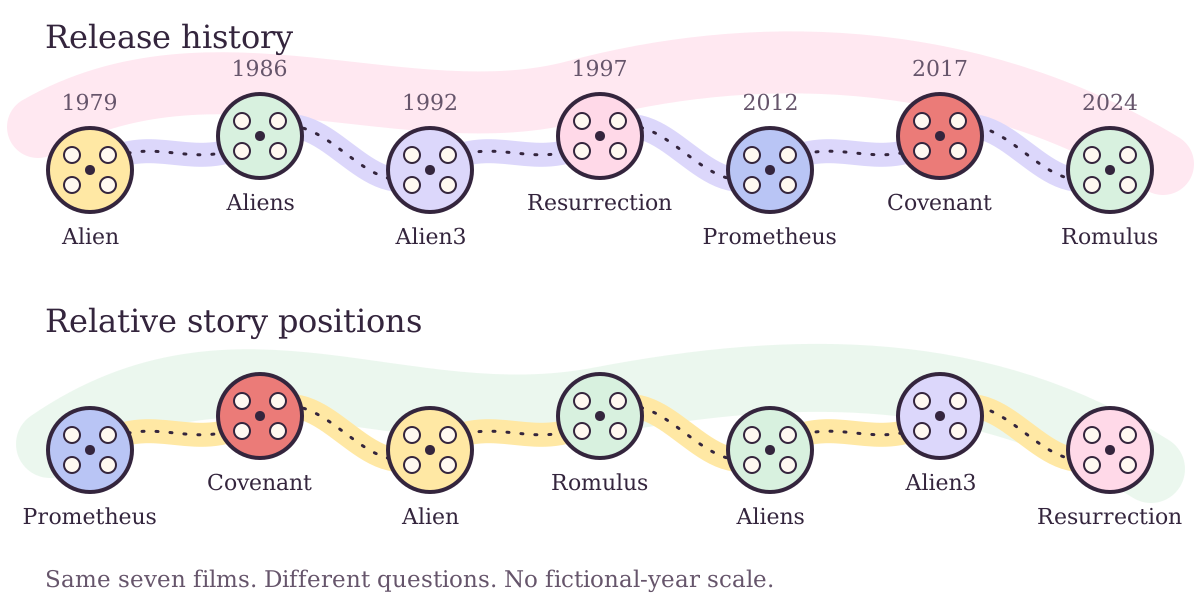
For a first encounter, our recommendation is to start with Alien (1979) and follow release order through this seven-film set. Story order makes a different choice: it moves Prometheus and Alien: Covenant before the original, and places Alien: Romulus between Alien and Aliens. Neither list is a ranking.
This guide selects the seven feature films released from 1979 through 2024. Television, the Alien vs. Predator crossovers, shorts and other media sit outside our chosen scope. That boundary keeps the decision manageable; it is not a declaration about what counts as canon or a promise to include every future release. The 2025 Alien: Earth announcement also distinguishes the television project from this seven-film span.
We discuss titles, years and relative positions without revealing endings or explaining the creatures’ origins. Even knowing that a story happens earlier is a small piece of context. Studio synopses and the linked interview may disclose considerably more. For a broader way into the genre, start with our Horror hub.
Release order: let the original introduce the world
The years below are release years from the studio’s US catalogue, not fictional dates. Canadian readers can use the same titles and relative sequence without treating these as a separate record of Canadian opening dates. Each linked title leads to its studio entry.
- Alien (1979)
- Aliens (1986)
- Alien3 (1992)
- Alien Resurrection (1997)
- Prometheus (2012)
- Alien: Covenant (2017)
- Alien: Romulus (2024)
The practical benefit of this route is restraint. You can meet the first film on its own terms, then discover what later filmmakers chose to extend, revisit or explain. A later-made prequel may ask you to think about a world differently even while depicting earlier events. Starting with the earliest story position would make that later perspective your first one.
That is why release order is our default for a newcomer, rather than an official requirement. If you only want to try the franchise, begin with one film. You do not have to book seven evenings before deciding whether its particular mixture of space, work and danger interests you.
Story positions: move three films, keep the labels
Within this selected set, the broad sequence is below. The parenthetical years still identify the films’ releases. This is a relative story map; it does not rearrange every flashback or claim to settle every continuity question.
- Prometheus (2012)
- Alien: Covenant (2017)
- Alien (1979)
- Alien: Romulus (2024)
- Aliens (1986)
- Alien3 (1992)
- Alien Resurrection (1997)
Two relationships explain the main changes. In Erik Davis’s 2016 Fandango interview, Katherine Waterston places Covenant between Prometheus and the first Alien. Disney’s 2024 slate description places Romulus between Alien and Aliens. Those relative positions are enough to choose a route; an elaborate future-year spreadsheet is unnecessary.
Notice the distinction between an insertion and a replacement. Moving Romulus into that gap does not make it a new version of Aliens. Likewise, putting Prometheus first on a story map does not change the fact that Alien was the original theatrical starting point. The title and release year travel together even when the position changes.
What do you want the next film to answer?
Choose the question that sounds like your evening. Open the note to see the tradeoff; these are editorial options rather than a test with one correct answer.
“I want to discover the series without preparing a dossier.”
Start with Alien, then continue through the release list if you want more. Leave the prequels where they were released. The advantage is a clear starting point; the tradeoff is that the story later looks backward. You can accept that change without having missed a hidden introductory film.
“I have seen these before and want to compare earlier causes with later stories.”
Use the story-position list, beginning with Prometheus and Covenant. This puts the earlier-set material up front. It also means setting aside the first-release progression. The map helps organize a revisit; it does not guarantee that all questions receive a neat answer.
“I only need to understand where Romulus belongs.”
On the story map it sits after Alien and before Aliens. On the release list it follows Covenant. Decide whether you are arranging a story sequence or following how the films reached audiences before moving it. We recommend the release route for a first watch, without treating chronology as homework.
Keep version, scope and availability as separate decisions
A viewing order selects titles. It does not identify which cut a particular listing offers, establish content suitability or promise that one subscription includes the whole sequence. Before pressing play, check the full title and year, the edition’s label, local content information and the access terms for your account. Do not fill an absent film in a streaming catalogue with a different movie that shares the franchise name.
You can also make a shorter plan honestly: write down which films you are leaving for later. A deliberate pause is easier to understand than a list that silently calls a selected route complete. Keep the remaining titles nearby, and return when a question makes another branch interesting.
For the next step, explore how suspense differs from a sudden scare, or compare the general tradeoffs in our watch-order decision guide. The useful order is the one whose purpose you can explain before it reveals the story.