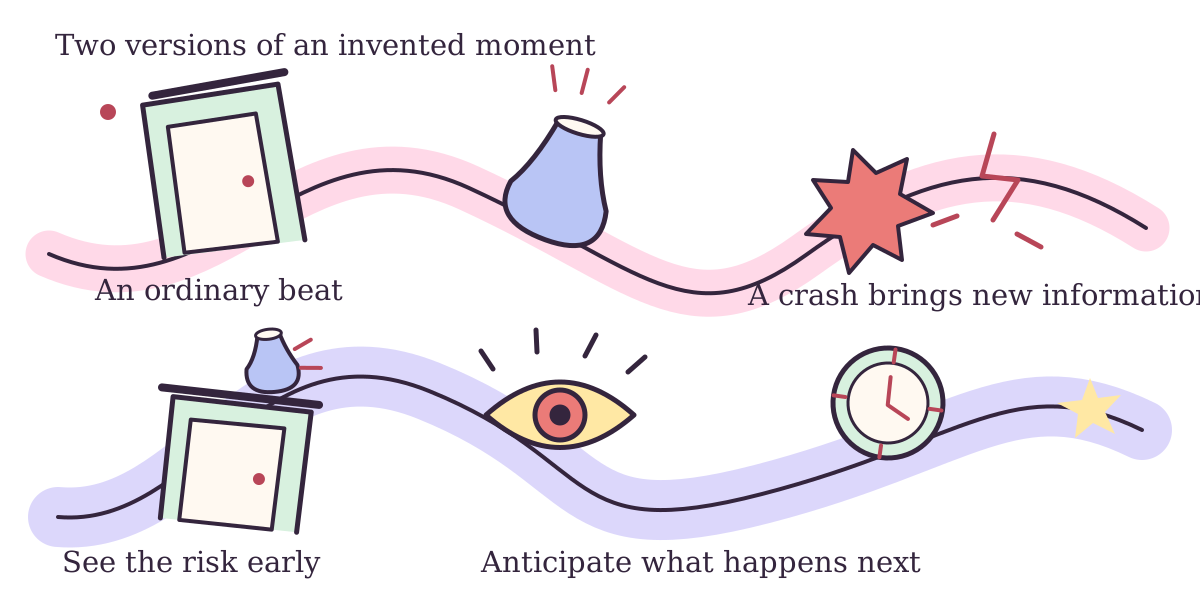
Suspense gives you an outcome to anticipate; a jump scare gives you a sudden sensory jolt. A scene can do both: let you worry about what is coming, then surprise you with exactly when or how it happens. The useful distinction is between the waiting and the abrupt event, rather than between two opposing kinds of film.
This is a craft guide, not a ranking of frightening movies. The main text discusses a small editing detail from Sabotage and sound craft in The Birds without revealing their outcomes. An optional disclosure explains one Cat People scare. Our other scenes are clearly labelled inventions. For a starting film, visit the Horror hub.
Start with what the audience can anticipate
Imagine a person approaching a door. On a high shelf above it, a vase is wobbling. If you see the unstable vase before the person touches the handle, a simple action acquires a possible consequence. The person can still turn away, notice the shelf or open the door. You have enough information to worry about those alternatives.
Now remove the early glimpse of the vase. The person opens the door and a crash suddenly interrupts an ordinary moment. That version gives you much less time to anticipate this particular event. The surprise arrives with the information. These are two versions of our invented scene, not descriptions of a released film or predictions of how every viewer would react.
Knowing more does not make the outcome certain. It creates a question with stakes: will the character notice in time? Conversely, withholding information does not automatically create suspense. If nothing directs your attention toward a consequential possibility, you may simply be waiting for the scene to explain itself.
A jump can punctuate the waiting
For this guide, a jump scare means an abrupt audiovisual event arranged to startle: a sudden appearance, movement, sound or combination. A revelation can surprise you without that kind of jolt. Learning quietly that a trusted character has lied is a narrative surprise; a sharp noise can make you jump without revealing a lie or even a new threat.
The distinction also explains why knowing a scare is coming need not make it ineffective. The uncertainty can move from whether something will happen to when, where or to whom. A quiet passage may prepare that attention. Loudness alone does not tell us how the passage organizes it.
Optional scene spoiler: the bus in Cat People (1942)
BFI’s Val Lewton introduction describes a character hurrying through Central Park, fearing a panther is following her. The sudden hiss comes from a bus. The anticipated source of danger and the actual source of the startling sound are different.
Our reading: the scene demonstrates why suspense and a jump are compatible. The earlier uncertainty makes a particular explanation available, while the abrupt sound momentarily demands attention. Identifying the bus answers the immediate sound question; it does not make every larger concern in the film disappear.
Editing can move the question between people
In his own 1937 account of filmmaking, Alfred Hitchcock describes constructing a dinner scene in Sabotage from separately photographed pieces: a hand holding a carving knife, eyes, and the other person’s responses. His account connects the changing attention to the knife with the tension between the characters.
That gives us a useful analytical task without turning his method into a rule for every thriller. Ask what each cut adds. Is the object newly visible? Has someone noticed it? Does a reaction change what you think they may do? A close-up can supply information, but the next shot determines whose knowledge matters. Repeatedly showing an object without changing its significance is a different effect.
Sound can describe a space before you see it
Do not reduce horror sound to a music cue before a loud bang. AFI’s presentation of The Birds identifies Bernard Herrmann’s supervision of the bird-sequence sound design rather than a conventional score. The craft question is what the sounds make perceptible, not simply whether a scene contains music.
In the imagined door scene, a faint scrape could suggest that something is shifting beyond the visible action. Silence could leave you watching for movement instead. A later crash might confirm the vase has fallen while withholding who is nearby. Picture and sound can answer different parts of the same question.
Try changing only the information
Keep our door, person and vase. Choose one version below and consider it before opening the explanation. Nothing plays and no sudden sound is hidden in these controls.
The viewer sees the vase first; the character does not
The gap invites anticipation. Track what might close it: a glance upward, a warning, a change of route. The crash could still startle, but the scene has already given the waiting a specific subject.
The viewer and character discover the shelf together
The question can shift from recognition to response: what will this person do? Suspense does not require the audience to know more. Shared uncertainty can still involve an urgent decision.
The crash arrives before either has noticed the vase
The event supplies the missing information abruptly. To analyze what follows, ask what the crash changes: someone could be hurt, a secret could be exposed, or the interruption could be harmless. A jolt and its narrative consequence are separate things to discuss.
On your next watch, replace “that was scary” with one more precise observation: what did you expect, what information created that expectation, and what changed it? For the visual half of that question, continue with how a frame includes and excludes information. For pressure created by a setting, try the craft of a bottle episode.