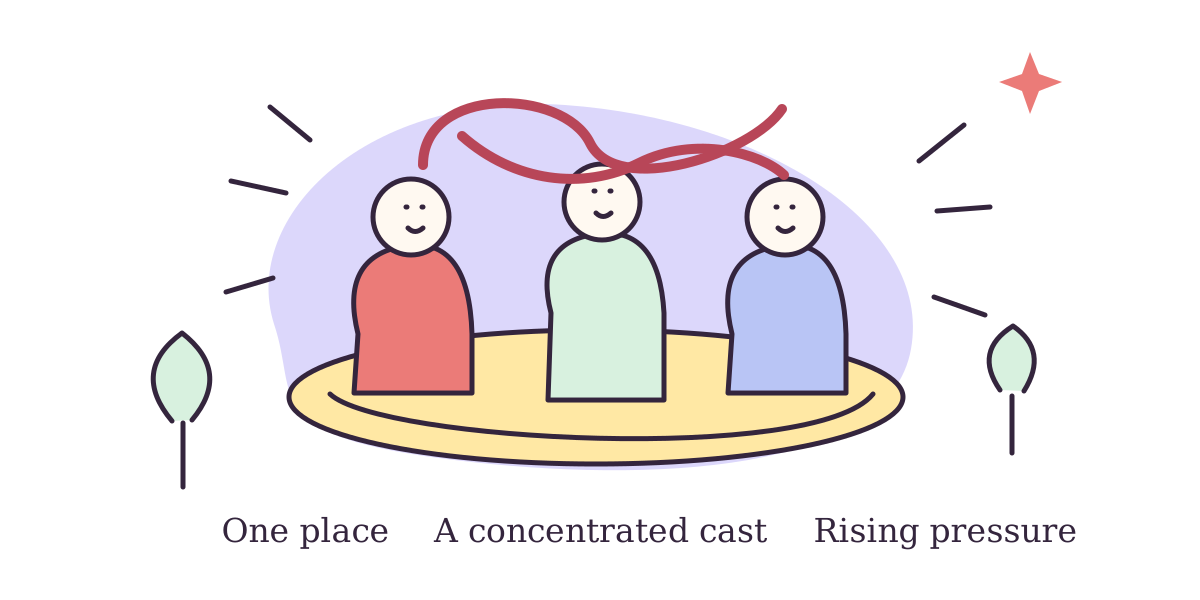
A bottle episode concentrates a television story into a limited physical space and cast. The BFI’s explanation connects that approach with saving production time and money. For the viewer, though, the interesting result is concentration: the story has fewer places to escape, so attention moves toward behaviour, relationships and the rules of the room.
This is a craft explainer, with premise-level examples from Doctor Who and Inside No. 9. It does not reveal their resolutions. Our interpretation of how confined storytelling works is separate from the production and episode facts linked below. We are not claiming a particular episode’s budget, shooting schedule or behind-the-scenes motive without evidence.
A smaller setting changes what counts as movement
In a travel-heavy adventure, movement is easy to recognise: someone reaches a new place, discovers a new object or encounters a new group. Confined drama has to make other changes legible. An alliance can shift. A repeated phrase can acquire a different meaning. Someone who seemed authoritative can lose the room.
Those changes can produce substantial narrative movement even when nobody travels very far. The useful test is not “Did the characters leave?” but “Is the situation meaningfully different now?” A scene can change the balance of power without adding a new location, and an episode can feel busy while withholding the usual visual refresh of a scene change.
That is also why merely putting people indoors does not automatically make an episode a bottle episode. A sprawling interior story can still require many sets, performers or effects. And an intimate-looking episode is not proof that it was cheap. The label is most helpful when it describes a real concentration of the production and the drama, rather than functioning as an insult.
Midnight: the group becomes part of the danger
The official Doctor Who record identifies “Midnight” as a Russell T Davies story that premiered on 14 June 2008. Its premise involves the Doctor trapped on the planet Midnight as fear turns a group against itself. The BFI uses the episode’s vehicle confinement as an example of bottle storytelling.
The useful craft idea is that a confined group can amplify a threat rather than simply witness it. Each person’s reaction changes what the others believe is safe, credible or possible. The outside problem and the social problem become entangled. You do not need the ending explained to watch for that pressure moving between people.
Pay attention to the difference between a character having information and a character persuading the group to listen. In a confined story, authority is something the scene can build, test or take away. The geography stays relatively stable while the social map becomes unstable. That is a richer lens than treating the room as a pause in the “real” adventure.
The Bill: an ordinary ritual becomes a contest
The BBC’s post-production script for Inside No. 9’s “The Bill” opens at a restaurant and brings four men together at a table; an early request is simply for the bill. The script credits Steve Pemberton and Reece Shearsmith. The full PDF gives away the story, so save it until afterwards if you prefer to avoid spoilers.
As an entry point for thinking about craft, that everyday situation is enough. A table gives everyone a relationship to everyone else. A small object can organise the conversation. A familiar social ritual supplies expectations that a writer can stretch: who offers, who refuses, who waits, and who decides when the interaction is over?
Confined storytelling makes these tiny acts easier to notice because the environment does not keep replacing them. The setting becomes a measuring device. We can compare one gesture with the next and register the difference. That is an editorial reading of the form, not a claim about why the production chose its location.
Look for changing pressure, not a checklist of ingredients
Useful questions for a bottle episode are simple: what prevents an easy exit; what keeps the people involved; what information changes hands; and what becomes harder to say as the episode continues? An exit need not be physically locked. Embarrassment, obligation, curiosity or competing goals can keep a conversation alive.
A spoiler-free viewing exercise
At the beginning, notice who appears to control the situation. Halfway through, ask whether that person still controls it, and what changed. At the end, compare the emotional distance between the characters with their physical distance. You can do this without predicting a twist or looking up an explanation.
Constraint is a form, not a guarantee
A small space cannot rescue inert writing, and a crowded production cannot replace a compelling scene. Our case for bottle episodes is that restriction can make a show expose its working parts: voice, timing, conflict and attention. Watch for what becomes possible when the story stops moving outward.
For the larger question of whether a series expects you to carry context between episodes, read our guide to episodic, serialized and anthology television. To explore a recurring world with a more explicit viewing route, enter the Stargate hub. Both questions are useful; neither requires turning television into homework.