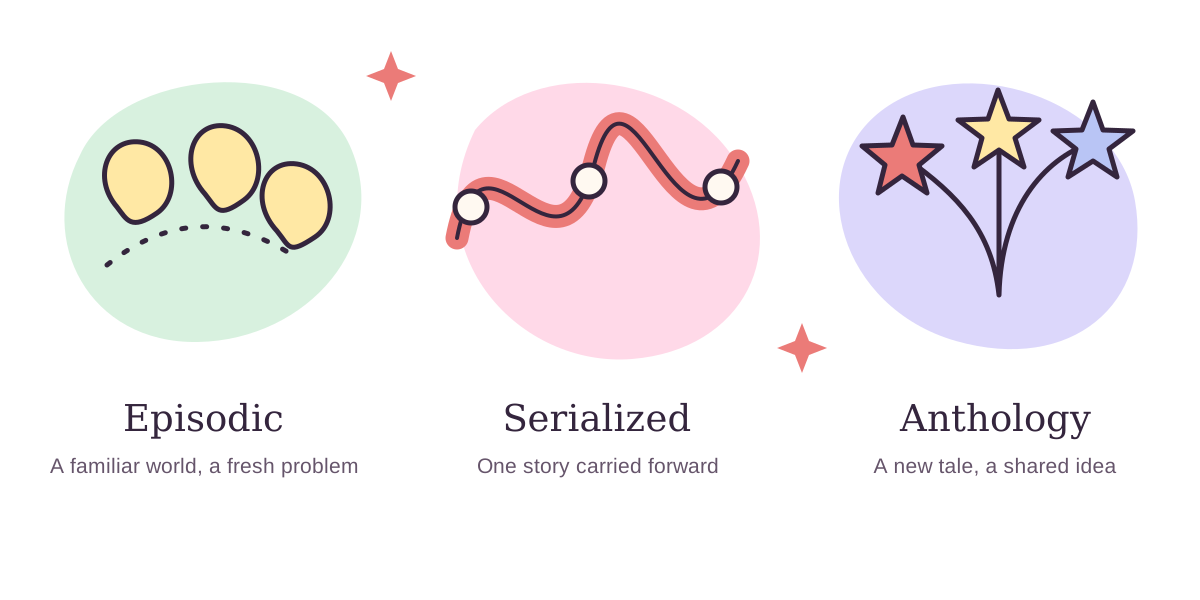
The quick distinction: an episodic show gives each instalment a substantial story of its own; a serialized show carries a continuing story between instalments; an anthology introduces a new story, cast or setting at an episode or season boundary. These describe different kinds of continuity. They are useful starting questions, not three sealed boxes.
For a viewer, the useful question is less “Which label wins?” and more “What does this episode expect me to remember?” A familiar setting can welcome you back while an unfinished relationship quietly makes earlier episodes matter. Our recommendation is to look for the show’s actual unit of satisfaction: one episode, a multi-part story, a season or the whole run.
Episodic television: a return visit with a new problem
An episodic structure brings a recognisable world back into focus, then offers a case, adventure or situation with a meaningful shape of its own. Characters can recur. Relationships can develop. The important feature is that the individual episode does more than transport you to the next one.
That gives television a particular pleasure: familiarity without identical repetition. The audience learns the ensemble’s habits, then notices how a new problem rearranges them. A disagreement can be interesting because we recognise the people having it, even when the immediate situation is new.
Consider the premise of Stargate SG-1. Amazon MGM describes a recurring Earth team travelling to other planets through the gate. A new destination supplies a fresh question while the same team carries experience forward. That premise helps explain why an adventure can feel locally satisfying without making the wider series disposable. For its actual viewing path and crossover checkpoints, use our researched Stargate guide.
Serialized television: the handoff is part of the story
A serial makes continuation central. A choice changes the conditions of the next episode; a question remains deliberately unresolved; a character’s later behaviour depends on what happened earlier. The European Broadcasting Union’s vocabulary identifies a serial through a continuing story told in episodes. Its separate definition of a series is broader, which is a useful reminder that everyday labels and catalogue terms serve different jobs.
The viewing consequence is straightforward: start at the beginning of the continuing narrative unless there is a clearly explained alternative. Jumping into an arbitrary instalment can make carefully planted uncertainty look like missing information. “I do not understand this yet” and “I have skipped the explanation” are different experiences.
Serialization does not require an episode to feel incomplete. A strong instalment can have its own argument, emotional turn or formal experiment while leaving the larger situation changed. A cliffhanger is one technique for that handoff; it is not the definition of serialized storytelling.
Anthology television: identify where the reset happens
An anthology organises distinct stories under a shared title or idea. The reset may happen every episode, or between seasons. Before choosing a starting point, find that boundary. A season-long anthology story can still be serialized within that season: “new story next season” does not mean “any episode in this season will do.”
Netflix describes Black Mirror as an anthology whose stories range across tones. That makes mood a reasonable way to choose many of its episodes. But the label cannot replace specific viewing advice: Netflix also identifies “USS Callister: Into Infinity” as a sequel to the earlier “USS Callister”. Watch the earlier story first if you want that continuation in order. The linked explainer reveals major plot details; the basic relationship is all you need before watching.
Most useful classifications leave room for a mixture
Think of continuity as several threads rather than an on/off switch. One thread is the immediate problem. Another is character history. Another is a larger mystery or conflict. A show can resolve the first while advancing the other two. Calling it “episodic with an ongoing arc” communicates more than arguing that it must belong entirely to one category.
Likewise, anthology episodes can share references without making every reference required homework. A small nod rewards recognition; a direct sequel asks for narrative context. A guide should explain that difference instead of turning every connection into a compulsory stop.
Choose the viewing habit that suits you
For a complete story tonight: choose a genuinely self-contained instalment or anthology story and check for sequel exceptions. For a longer commitment: begin the serial at its narrative entry point. For a familiar world: try an episodic series, while expecting recurring characters to accumulate history. None of these structures is a quality ranking.
Read the promise, then decide how much to commit
A format label is a promise about the shape of attention a programme asks from you. It does not tell you whether the show is clever, moving, funny or worth your time. Use it to choose an appropriate first commitment, then judge whether the story fulfils its own promise. Our watch-order framework helps turn that preference into a route; our bottle-episode explainer looks at what happens when a story makes its physical world smaller instead.