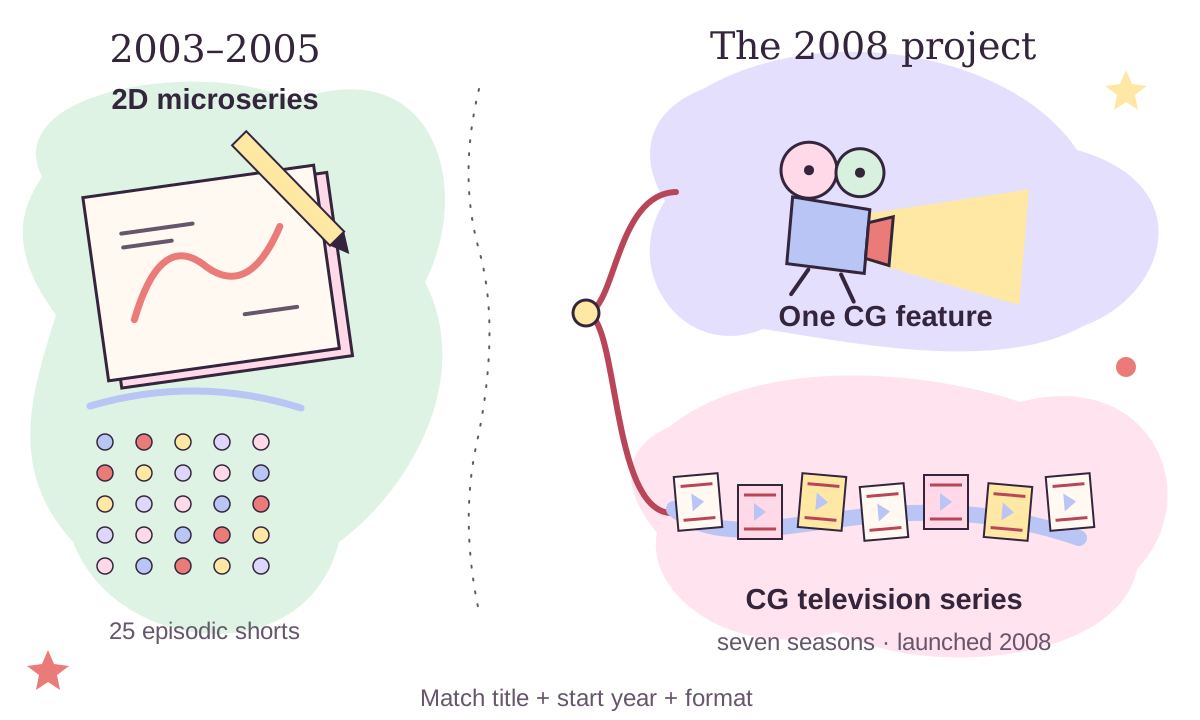
There are three screen objects to identify: Star Wars: Clone Wars, the 2D microseries that began in 2003; Star Wars: The Clone Wars, the computer-animated movie released in 2008; and the television series of that same title launched in 2008. The older shorts are a separate production. They are not a first season you must automatically complete before entering the 2008 film-and-series project.
The word The helps distinguish the familiar series names, but the 2008 movie and show both include it. They also share a start year. For a useful catalogue check, match title, year and format together. That gives you a clearer starting point than choosing whichever result happens to have the shortest title.
Jump to the three-object comparison, a 2008 entry route or the listing exercise. For the central live-action saga instead, use our Star Wars hub.
Three objects, two production paths
| Programme | Identity clue | What it contains |
|---|---|---|
| Clone Wars, 2003–2005 | 2D microseries | 25 episodic shorts |
| The Clone Wars, 2008 movie | Computer-animated feature | One theatrical film |
| The Clone Wars, series launched in 2008 | Computer-animated television | A seven-season series |
Lucasfilm’s microseries record identifies Genndy Tartakovsky as director of the 25 shorts and dates their television run to 2003–2005. It expressly distinguishes that production from the separate 2008 movie and series. A shared setting and familiar names therefore do not turn the older project into a numbered season of the later show.
The official animation history describes the 2008 feature debut followed by the television series, ultimately seven seasons. The film’s own record identifies the theatrical object separately. When someone recommends “Clone Wars,” the useful follow-up is which of these they mean: a collection of shorts, one movie, or a series commitment.
A shared era still needs a clear label
Lucasfilm places the microseries and the later series broadly between Attack of the Clones and Revenge of the Sith. The 2008 production record gives that setting for the later show. An era label locates a story; it does not establish that every production set there is another consecutive part of one viewing queue.
Keep two questions apart when choosing: “Which production am I opening?” and “What order will I use within it?” Solving the first stops a search result from quietly switching you into a different project. Solving the second lets you choose the kind of discovery you want. You can sample the older microseries as its own visit without forcing its shorts into every gap in the later series.
Entering the 2008 film-and-series project
For a release-led entrance, our recommendation is the 2008 movie, followed by the television series from season one in broadcast order. This keeps the feature that introduced the project ahead of the show that followed it. It is a straightforward editorial choice, rather than a claim that the film depicts the earliest event in the project’s story.
If you prefer fictional chronology, Lucasfilm publishes an official sequential list that includes the movie among the episodes. Its opening positions make the distinction concrete:
- Cat and Mouse — season 2, episode 16.
- The Hidden Enemy — season 1, episode 16.
- The Clone Wars — the theatrical movie.
That is a selected opening example, not the complete chronological route. Continue with the official table if this is the arrangement you choose. The season-and-episode codes identify where an episode sits in the broadcast catalogue; the position in the sequential list answers a different question. “2.16” does not mean sixteenth in that chronological list.
Neither choice requires treating the 2003 microseries as an unlabelled prologue to the 2008 show. Choose that separate production because you want to explore it. Our watch-order guide explains the broader tradeoff between release-led discovery, story chronology and smaller samples.
What Lucasfilm’s classification tells you
Lucasfilm’s current microseries page describes the 2D production as outside the official Star Wars story. That is an attributed statement about story scope. It does not decide whether you will enjoy its animation or prefer it to another production. This guide uses the classification to keep the projects distinct, while leaving taste to the viewer.
For the wider distinction between an official story policy, connections within a story and a viewer’s interpretation, read canon, continuity and fan theories. Familiar characters or shared voice performers can connect productions creatively without establishing that all their earlier events carry into the same continuity.
Practice the title, year and format check
These are imagined catalogue clues, not copied listings or availability claims. Predict what each one establishes, then open its explanation.
“2003 · Clone Wars · 2D Micro-Series · 25 shorts”
The combined clues identify the older microseries. You have found a separate production to explore, rather than season one of the 2008 television show. A collection may package shorts together; the programme identity still comes from the full description.
“2008 · The Clone Wars · movie”
The format identifies the theatrical feature. The year and title also appear on the television project, so “movie” is doing useful work. For our release-led entrance, this is the object before the television series.
“2008 · The Clone Wars”
The film-versus-series question is still open. Look for the programme format. For a television entry, add season and episode title to the passport; for the feature, confirm that it is the movie. The word “The” alone cannot finish this check.
Once the object is clear, a route can stay pleasantly small. You can choose a feature, a series or a separate set of shorts without committing to every screen branch. Return to the Star Wars hub for the larger map.