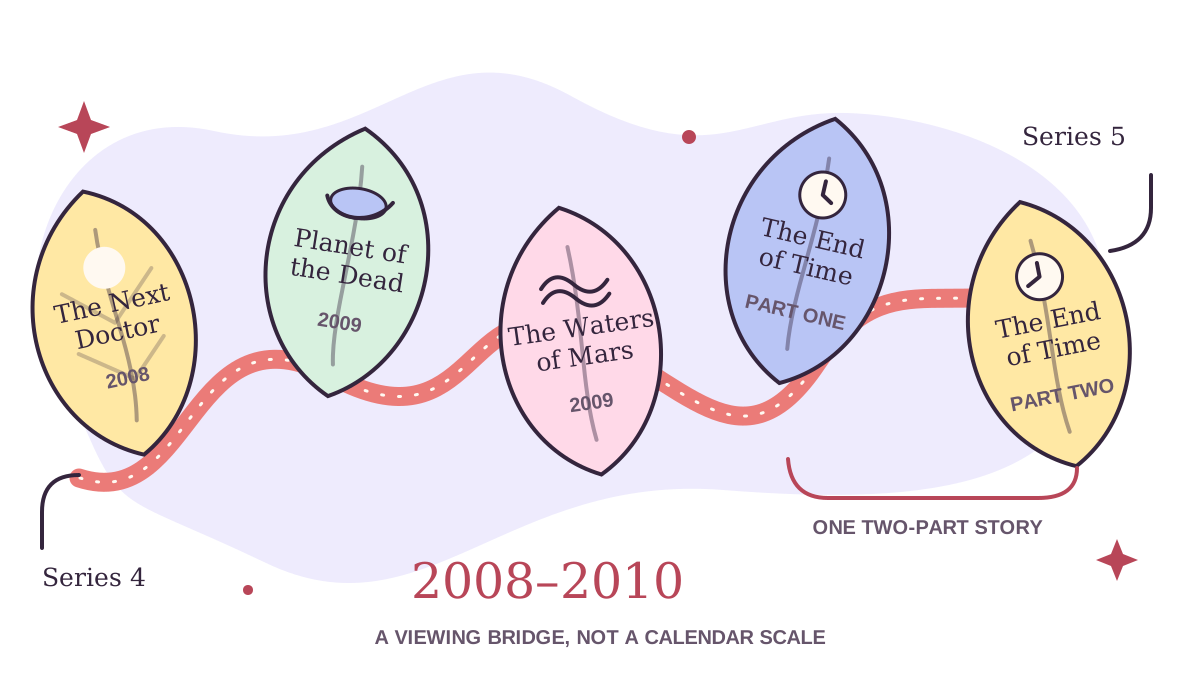
After Series 4, watch The Next Doctor, Planet of the Dead, The Waters of Mars, then both parts of The End of Time. Continue to The Eleventh Hour, the opener of Series 5. That is the five-episode bridge often called the “2009 specials,” although its original broadcasts stretch from Christmas 2008 to New Year’s Day 2010.
The official specials announcement explicitly places these episodes between the fourth and fifth series. This guide helps you find that particular stretch without reading its endings. It covers the five main live-action broadcasts in the official set, rather than every short, animation or spin-off. Titles and dates follow below; plot resolutions do not. The linked official records are less spoiler-shy, so use them with care.
The bridge, in viewing order
These are original UK premiere dates from the official story records. They identify the sequence, not when an episode aired in the United States or Canada. Dates are written out to avoid turning the catalogue’s 11/04/2009 into a November date.
The Next Doctor — . The opening stop, even though a “2009 specials” label can make its 2008 date look out of place. Official episode record.
Planet of the Dead — . The next full-length broadcast in this bridge. Match the title before relying on a season number. Official episode record.
The Waters of Mars — . Keep this before The End of Time. A calendar-year sort alone will not explain a differently packaged season. Official episode record.
The End of Time — Part One — . The first half of the two-part story. Make sure Part Two is also in your selected package. Official episode record.
The End of Time — Part Two — . The last episode in this five-episode bridge. Its 2010 date does not move it after the next numbered-series opener. Official episode record.
After Part Two, the next numbered-series opener is The Eleventh Hour, Series 05, Episode 1. Its original UK premiere was 3 April 2010. There is no need to sort all the 2010 entries alphabetically or assume that a New Year special belongs after an April opener.
In the illustration, the connected leaves show order rather than elapsed time. The gaps between broadcasts were unequal; the decorative spacing is not a calendar. The shared bracket under The End of Time marks one two-part story, while preserving two separate episode stops.
Five episodes, four story titles, three calendar years
A listing can look incomplete before anything is actually missing. The End of Time may appear as one heading with two parts beneath it. Count the playable parts, not just the top-level headings. Conversely, a result called “Part One” is not evidence that Part Two comes with it.
The years create another small trap. “2009 specials” is convenient shorthand for this bridge, but The Next Doctor belongs at its beginning despite its 2008 premiere, and The End of Time — Part Two belongs at its end despite its 2010 premiere. The official programme site calls the group Specials 2008–2010. Using that span alongside the individual titles is more precise than treating “2009” as a strict filter.
This is also why I would not use “special” as a synonym for “skippable.” In this route, the question is where a broadcast sits between the numbered series. Its scheduling label does not answer how you want to experience the story. My recommendation for a first journey through these years is to keep the whole five-episode bridge in order.
Find the right items without opening a plot summary
- Start with the era. You want the revived programme’s bridge after Series 4, rather than an unrelated collection with “specials” in its name.
- Match the five titles and parts. Use the list above as a contents checklist. Treat a package label as a clue, then inspect what it actually contains.
- Check the boundaries. Look separately for the December 2008 opener and January 2010 conclusion if a listing only advertises “2009.”
- Confirm the next opener. Once you finish Part Two, continue with The Eleventh Hour. Save episode synopses, character pages and finale thumbnails for later if you are avoiding spoilers.
For US and Canadian readers, this method is deliberately based on titles and parts. A historical UK product announcement does not establish your local service’s current catalogue, the contents of a North American disc release or an entitlement attached to your account. Check the actual release you will use. For the wider numbering problem, our Doctor Who series-versus-season guide explains why a season number alone can be an unreliable address.
Untangle the listing in front of you
My collection shows four titles, rather than five.
Open The End of Time’s contents and look for Part One and Part Two. Four story headings can contain the five episodes in this route. If only one part is identified, do not infer the other from a similar cover or a collection name; check the actual contents.
My listing only says “2009 specials.”
Check for The Next Doctor at the start and The End of Time — Part Two at the end. Their original 2008 and 2010 dates explain why a strict year filter can be unhelpful. The label alone does not establish whether your particular package contains them.
The box also lists Dreamland and The Infinite Quest.
The official 2019 UK steelbook announcement describes those animations on a bonus disc, separately from the five main specials. That is a useful packaging distinction for that release. Our five-episode bridge does not insert the bonus disc into the live-action list, or claim that every edition includes it.
Keep the bridge small enough to enjoy
You do not have to turn a short gap between series into an entire franchise completion project. My practical plan is to identify the five episodes first, then choose comfortable viewing sessions. Keep the two parts of The End of Time consecutive in your order, even if you watch them on separate evenings. The ordering matters more than finishing in one sitting.
If you arrived here before choosing your first Doctor Who adventure, head back to the Doctor Who starting-point hub. If you are already following the 2005 programme, this page is a bridge you can keep beside that journey. The next useful click is the episode you meant to watch, rather than a spoiler-filled explanation of everything you have not reached.