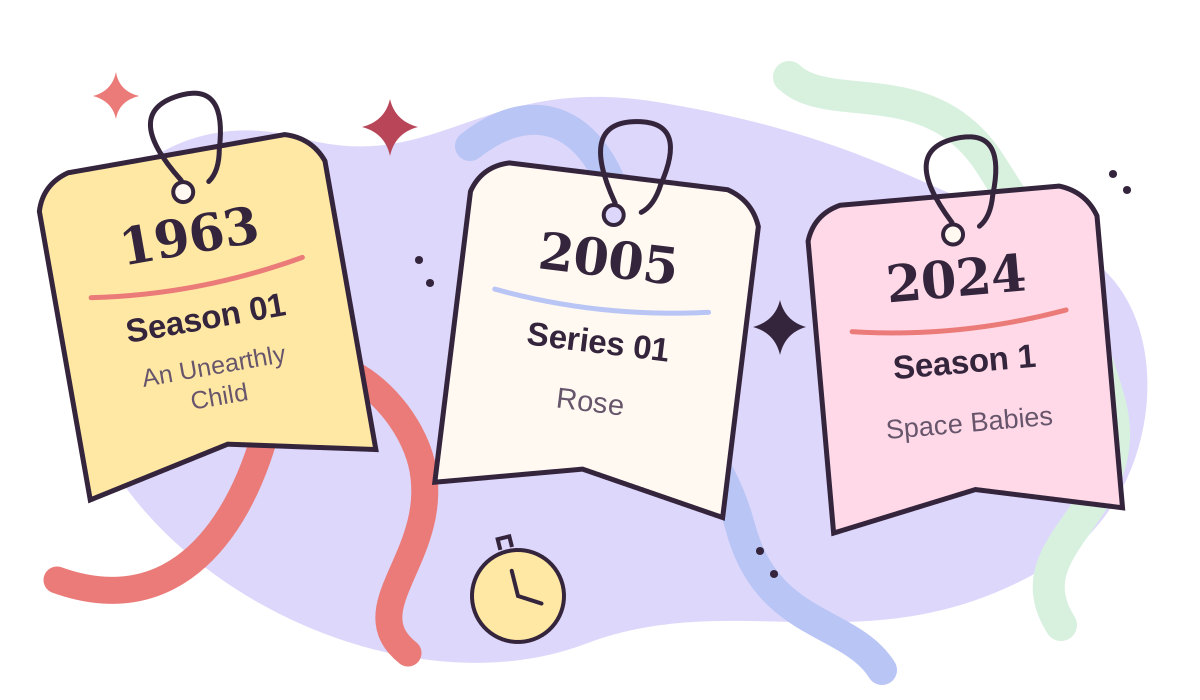
For Doctor Who, “season one” is an incomplete address. It can point to the original 1963 run, the 2005 revival or the run beginning in 2024. Changing the word series to season does not resolve that ambiguity. Add a year and an episode title before following a recommendation, buying an edition or deciding where to resume.
This is a guide to identifying a listing, rather than another recommendation to watch the whole programme. Our Doctor Who hub helps you choose a starting point. Here, the job is to make sure the episode on your screen is the one you meant. The examples below reveal titles and casting, but no story resolutions. Linked source pages can contain synopses and spoilers.
Three first runs, three useful identifiers
These are bounded examples from the official story catalogue, checked on 2 November 2026. The dates identify the programme record’s premieres, rather than claiming those episodes first reached every country on the same day.
- 1963: Season 01, EP 1. The official An Unearthly Child record identifies William Hartnell as the Doctor and lists four instalments, beginning on 23 November 1963.
- 2005: Series 01, EP 1. The official Rose record identifies Christopher Eccleston and gives 26 March 2005 as the premiere.
- 2024: Season 1, EP 1. The official Space Babies record identifies Ncuti Gatwa with Millie Gibson and gives 11 May 2024 as the premiere.
The repeated number is useful within its own run. It becomes confusing when it is detached from that run. Imagine sending someone a building’s apartment number without the street address: the number is accurate, but the directions are unfinished.
The US example: Rose can say “season” too
The distinction is not as simple as “the old run says season and the revival says series.” On the US Apple TV episode page checked for this guide, Rose is labelled S1, E1. The official Doctor Who page calls the same episode Series 01, EP 1. Its title, year and Doctor identify the work despite the different wording.
When comparing a recommendation with an American listing, match those details first. Do not reject the correct episode because the heading says season, or accept the wrong run because its number matches. If you use a Canadian catalogue, repeat the check in that territory; a US page does not establish what a Canadian listing includes.
Give an episode a fuller address
My recommendation is to save four things: programme, run year, title, and the number shown by your listing. For example: Doctor Who / 2005 run / Rose / S1 E1 on the US listing. The title is the anchor. The run year prevents you from dropping it into another season-one container.
When resuming, also note the last episode you finished and the next title you expect. This is more dependable than “I was halfway through season one.” You can put that note on paper; no account, viewing-history tool or detailed plot summary is necessary.
A special can belong with a later year’s season
The Church on Ruby Road has a 25 December 2023 premiere record, while Space Babies is the numbered season opener in 2024. In Disney’s dated US launch announcement, the 2024 launch included the earlier special alongside new episodes. A season package and a calendar year answer different questions.
There is a useful packaging example in the official UK home-video announcement: disc one contains The Church on Ruby Road; disc two begins with Space Babies, labelled episode one. That describes that UK edition, not every US or Canadian release. Before assuming a special is absent, inspect the actual episode or disc contents. Before assuming it is included, check its title.
“Episode one” can hide another unit of counting
The classic catalogue adds a second wrinkle. Its An Unearthly Child record labels the adventure EP 1, but lists four instalments: An Unearthly Child, The Cave of Skulls, The Forest of Fear and The Firemaker. A story-level record is not automatically a one-instalment record. Check the named contents instead of assuming every numbered entry has the same scope.
For a modern episode, the title can identify one instalment directly. For a classic serial, keep the complete adventure and its parts together in your note. This is an indexing distinction; it does not require knowing the plot.
Try a quick listing check
Open the situation that matches yours. These are editorial troubleshooting steps, rather than claims about every service’s interface.
My friend said “season one” and nothing else.
Ask for the opening episode title or the actor playing the Doctor. Match it to the three examples above, then add the run year. Do not infer the intended run from the number alone.
I found Rose, but the guide says Series 1.
Check that the listing identifies the 2005 episode with Christopher Eccleston. The US Apple example shows why “season” versus “series” can be a label variation for the same episode.
Space Babies is episode one, but someone says I missed a special.
Look separately for The Church on Ruby Road, then check whether your package includes it. Keep the special’s 2023 date separate from the 2024 season label. The title check resolves more than scrolling through numbers.
Once you have the right address, return to the Doctor Who starting routes. If the remaining question is how a series joins its individual stories together, our guide to episodic and serialized television takes the next step.