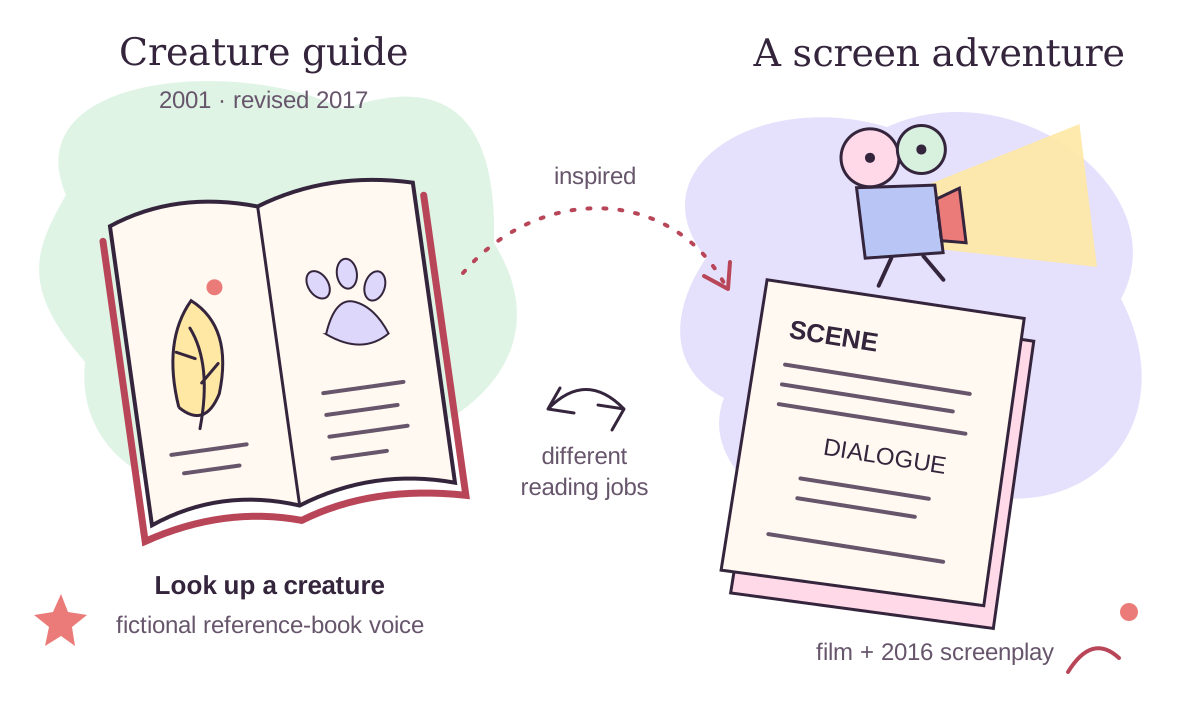
Fantastic Beasts and Where to Find Them can mean a creature reference book, a movie or the movie’s published screenplay. The Hogwarts Library book and The Original Screenplay are different reading experiences. If you want the New York adventure in written form, look for the screenplay. If you want a guide to magical creatures presented as a book from the wizarding world, look for the creature compendium.
The distinction matters more than the cover, the newest date or the familiar words at the start of the title. A newer creature-guide edition does not become a screenplay, and an illustrated book is not automatically the film’s story. This guide helps you identify the object in a listing without revealing the movie’s outcomes. Our Harry Potter hub handles the separate question of where the films fit in a viewing route.
The creature guide is a book from inside the world
The author’s Hogwarts Library book record explains the double identity. Fantastic Beasts first appears as one of Harry’s schoolbooks within the novels; a real-world companion book was published in 2001. Its fictional author is Newt Scamander. The actual author of the published work is J.K. Rowling. Calling Newt the fictional writer describes the book’s framing, rather than discovering a second real person behind it.
Think of the reading task as looking up creatures and exploring the world’s invented knowledge. That is a different task from following a cast through a sequence of dramatic scenes. A reference-book voice can be part of the fiction without turning the book into an ordinary novel about the person whose name appears on its imagined title page.
The same record identifies a revised edition published in March 2017. The author’s dated revision announcement specifies six additional beasts and a new foreword. Those changes extend the creature book. They do not make “2017” a universal code for the screenplay, nor establish which contents every later printing or format contains. Read the edition note for the particular copy.
The screenplay follows the screen adventure
The separate Original Screenplay record describes Newt’s arrival in New York in 1926 and identifies the film’s November 2016 theatrical release. Scholastic’s 2016 announcement calls the film a new story inspired by the Hogwarts textbook. That relationship is more precise than treating a creature directory as a novel whose chapters were directly translated into movie scenes.
A screenplay organizes a story for the screen: scene headings, action and dialogue give you a different reading rhythm from a prose novel or a reference entry. Choosing the screenplay means choosing that form, rather than expecting a novelization with continuous prose. Its relationship to the movie does not mean the two formats deliver every detail in exactly the same way.
Our practical recommendation is to watch first if preserving the movie’s discovery matters most to you, then read the screenplay to compare how a scene is expressed on the page. Reading first is also a valid preference. In either case, expect story information in the screenplay; it is not a spoiler-free companion simply because it is sold on a bookshelf.
Match the format to the reading job
| Object | Useful clue | Choose it for |
|---|---|---|
| Creature guide | Hogwarts Library or creature-compendium description | Reference entries and fictional natural history |
| Published screenplay | The Original Screenplay subtitle and script format | The screen adventure in written dramatic form |
| Movie | A film listing with a playable or physical video edition | The performed, edited picture-and-sound experience |
The drawing above connects inspiration and format, rather than placing the three objects into a required reading sequence. You can browse the creature book independently of a movie night. You can also study a screenplay after seeing its film without making every creature entry required preparation. Decide what you want to do before trying to collect everything that shares the title.
The U.S. and Canadian edition check
Scholastic’s announcement identifies its 2016 hardcover screenplay for the United States and Canada with ISBN 9781338109061. The Canadian publisher’s record pairs that number with The Original Screenplay. It is a useful match for that particular edition, not a claim that every screenplay, ebook, translation or later format must have the same ISBN.
For a library search, secondhand listing or bookseller page, use four checks together:
- Format: is it a creature guide, script, audio edition or video?
- Subtitle or series: does the record say The Original Screenplay or describe a Hogwarts Library volume?
- Edition note: does it describe revised contents, illustrations or a particular printing? A year alone leaves those questions open.
- ISBN: does the number match the publisher’s record for the edition you intend to borrow or buy?
Cover art can help you recognize an item, but it is a weak final check: editions can change their packaging while sharing a main title. The publisher’s format description and edition identifier are more useful than assuming an unfamiliar cover represents an unfamiliar story. No current price, stock status or retailer recommendation is needed to make that distinction.
Try three imaginary listing clues
These are invented snippets for practicing the checklist, rather than actual products or copied storefront listings. Make a prediction, then open the explanation.
“Hogwarts Library · revised creature guide”
This points toward the compendium. Check the record for the actual revision and format before choosing it. The clue does not promise the film’s scene-by-scene story, and it does not tell you whether this particular edition is illustrated.
“The Original Screenplay · ISBN 9781338109061”
The subtitle and publisher-verified number identify the 2016 Scholastic hardcover screenplay discussed above. You have identified an edition of the screen story, rather than the creature reference book. The sample deliberately gives no price or availability.
“Fantastic Beasts · illustrated · a newer publication year”
There is not enough information yet. “Illustrated” describes presentation, and a year describes an edition’s publication record; neither by itself settles whether the contents are a creature guide or a screenplay. Read the full subtitle and description, then match the ISBN.
A small comparison, without a completion checklist
After choosing a format, ask what kind of attention it invites. A reference entry invites browsing and comparison; a script invites you to imagine a scene; a finished movie directs attention through performance, framing, sound and editing. Those are useful questions for your own reading or viewing, rather than a claim that we conducted a test of every edition.
For another kind of naming problem, read Sorcerer’s Stone versus Philosopher’s Stone. That guide distinguishes regional titles and film editions. Here the first question is more basic: are the listings even offering the same kind of work? Once you have answered it, return to the Harry Potter and Fantastic Beasts hub to choose the screen branch you actually want.