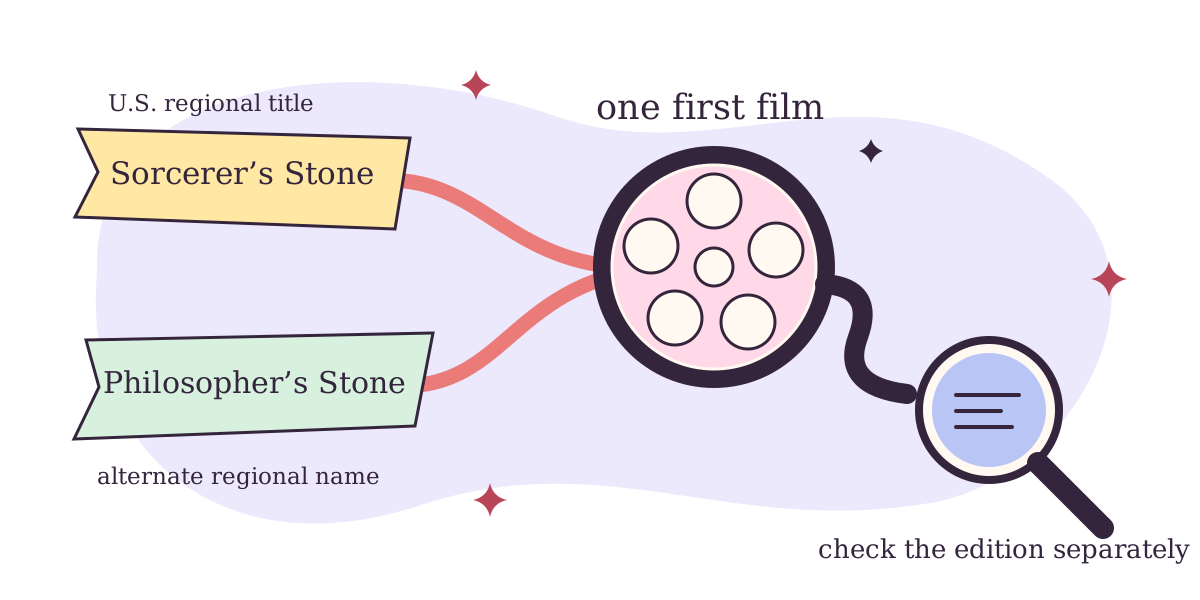
Harry Potter and the Sorcerer’s Stone is the U.S. title of the first Harry Potter film, also known as Harry Potter and the Philosopher’s Stone. They occupy the same first stop in the film series. You do not need to put both titles into a watch order. The useful next question is whether a listing also describes a particular edition or viewing mode.
That second question matters because a regional name and a feature package are different labels. One tells you how the work is titled; the other may tell you how it is presented. Here is how to read those labels without mistaking a familiar film for a missing installment. This guide discusses titles, dialogue wording and product descriptions, with no plot outcomes. External franchise pages may contain more story detail.
Why the first film has two names
The American Film Institute explains that the first novel’s title changed for American readers and that the film followed that naming choice. For a U.S. reader starting a movie search, Sorcerer’s Stone is therefore a useful primary term. If another guide uses Philosopher’s Stone, it has not sent you to a prequel or sequel.
The official film collection places the film under Philosopher’s Stone at the beginning of the eight-film Harry Potter sequence. Treat the alternate title as an identity match, then continue with Chamber of Secrets. There is one opening chapter on that route, even if a library search displays more than one result for it.
Does the difference extend to the dialogue?
Yes: AFI reports that scenes mentioning the stone were filmed with both terms for the different titles. That supports a precise claim: the regional wording was accommodated in the production. It would be misleading to turn “the same first film” into “every supplied version has identical spoken wording.”
It would also be a leap to identify a particular digital copy from its cover alone. AFI’s production account does not catalogue every current service’s video, audio and subtitle combination. If you are checking a copy you already own, note the title shown, the selected audio language and what is actually spoken when the term occurs. Those observations describe that copy; they do not establish a rule for every platform.
A regional title is not a bonus mode
There is a separate, documented presentation called Magical Movie Mode. The official announcement of Warner Bros. Home Entertainment’s release describes features including Chris Columbus commentary, deleted scenes, quizzes and graphic or audio additions during selected scenes. Its description uses both regional names for the underlying film.
This is a useful example of why the full product description matters. Sorcerer’s Stone or Philosopher’s Stone answers the title question. “Magical Movie Mode” answers a presentation question. The presence of the word “Sorcerer” does not establish that those features are included; the word “Philosopher” does not exclude them.
If a different listing says “extended,” “theatrical,” or offers extras, read that listing’s actual description. This article does not use the regional name to infer a runtime, a particular deleted scene or a complete edit comparison. Those are separate claims that need evidence for the edition in front of you.
Check the listing in three passes
- Identify the work. Match the full title to the first film. The alternate regional name is not an additional installment.
- Identify the presentation. Look for an explicit edition or mode label and its stated contents. Do not assume a bonus feature is part of the main playback merely because the cover looks familiar.
- Check what you need. Confirm the audio, captions, accessibility options and any physical-media compatibility information for that specific release before choosing it.
Canadian readers should make the same specific check rather than treating a U.S. search result as a description of the Canadian product. Our evidence establishes the naming relationship and one announced mode; it does not guarantee a current title, feature package or subscription entitlement in either country. The distinction keeps a durable explanation separate from a catalogue that can change.
Which question brought you here?
I just want to watch the first film
Either regional title identifies the right story. Choose an ordinary presentation that meets your viewing and accessibility needs, then follow the Harry Potter hub’s eight-film route. Watching both regional variants is an optional comparison, not a required step.
I want to compare editions
Keep two columns in your notes: what the provider explicitly promises, and what you observe in playback. “The listing says Magical Movie Mode” and “this playback includes commentary” are useful observations. “Every copy with this regional title has the same extras” goes beyond them.
For another example of why identity, version and presentation should be separated, explore the Stargate movies and alternate cuts. If you are more interested in what a restoration label can establish, read our film-restoration explainer.