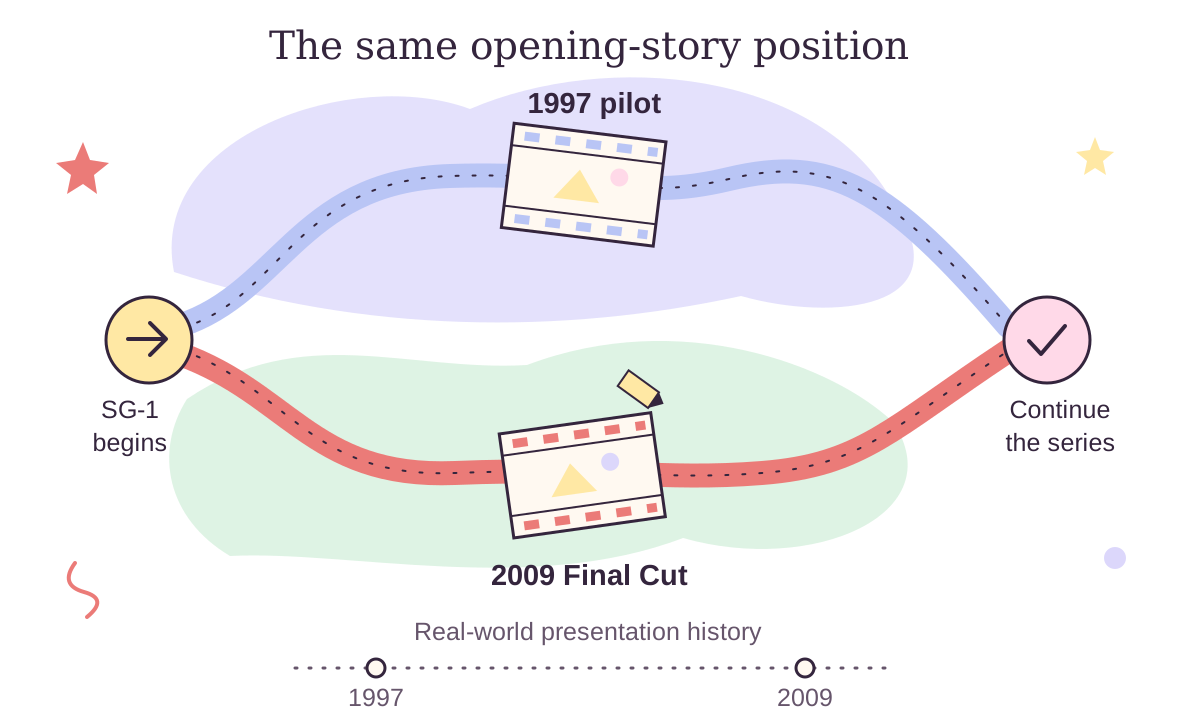
Children of the Gods is SG-1’s 1997 opening story. The 2009 Final Cut revisits that beginning with a different edit and presentation. Treat it as an alternative at the opening-story position in your watch list, rather than a new sequel to queue after the later SG-1 movies. You do not need to watch both presentations back to back to continue our main viewing route.
The practical question is which edition a particular listing actually identifies. A familiar title, a release year or a “movie” category can leave that unresolved. This spoiler-light guide separates the documented production relationship from clues that cannot, on their own, certify the version a service will play.
One opening story, two presentation questions
Richard Dean Anderson’s episode record dates the original opening to 27 July 1997. The Dragon’s Domain soundtrack account at BuySoundtrax describes MGM’s permission for producer Brad Wright to recut the pilot in 2009. The later date belongs to the reworking of the screen presentation; it does not move the opening adventure later in the fictional sequence.
Editing can involve more than deleting a few moments. A fan-preserved transcript of Wright and Anderson’s DVD commentary describes choosing different takes from the original dailies and working with editor Brad Rines. That is a transcript of participants discussing their work, with the limitations of fan transcription. We use it as supplementary evidence for the re-edit relationship.
Our illustration therefore forks at the opening story and rejoins the series route. Its separate publication-time line moves from 1997 to 2009. Those are two different maps: where a story belongs, and when a presentation of it was made. The Stargate movies guide applies that distinction to the later films and other assembled cuts.
A restored score is a useful distinction
The label’s account says Joel Goldsmith wrote a complete score for the pilot, while the original presentation also used selections from David Arnold’s 1994 film score. It describes the later recut as restoring Goldsmith’s orchestral music. “Restored original score” is more informative here than assuming a new edition means music newly composed in 2009.
This also creates a second kind of listing to recognize: a soundtrack album bearing The Final Cut title. That is a music product, not another screen chapter. Its release record, track list or duration cannot tell you the running order of SG-1 episodes. Follow the product format as carefully as the franchise name.
Build a small version passport
- Read the complete edition name. An explicit Final Cut label tells you more than the base title alone.
- Find the source of that description. A provider’s edition details or the package for the exact item are more useful than a comment describing somebody else’s copy.
- Separate format from cut. “Episode,” “movie” and “soundtrack” answer different catalogue questions. A category alone is not an edit identifier.
- Keep the year in its lane. It may identify an original work or a later edition. Ask what the record is dating.
- Leave an unknown unknown. If the provider does not confirm the cut, do not turn an inference into a guarantee.
For a concrete metadata example, the Apple TV U.S. movie record displayed the base title with 1997 when checked for this guide; the Google Play movie record displayed it with 2009. Neither observation establishes that their playback masters match or certifies an unlabelled version for your account. It demonstrates why a date should prompt a question rather than settle one.
Try the passport on three imagined listings
These are original practice snippets, not offers, purchase links or copied storefront interfaces. Open each explanation after deciding what the clue establishes.
“Children of the Gods — Final Cut · video”
The edition is explicitly named and the item is video. Check that the exact item’s provider or package supplies that description. You have a stronger edition clue than a bare year; you have not discovered a later sequel.
“Children of the Gods · movie · a release year”
The opening story is named, but the cut remains unconfirmed. The movie category and date alone are insufficient. Look for an edition description instead of guessing from the category.
“The Final Cut · original soundtrack · CD”
The format identifies an audio album. It may illuminate the score’s history, but it is not a video edition and does not add another adventure to the watch list.
Once you have identified the presentation you intend to use, continue the series rather than turning edition collecting into an entrance requirement. Comparing edits can be a later project if that interests you. Return to the Stargate hub for the larger route, or the movies guide to distinguish this revised beginning from subsequent story chapters.