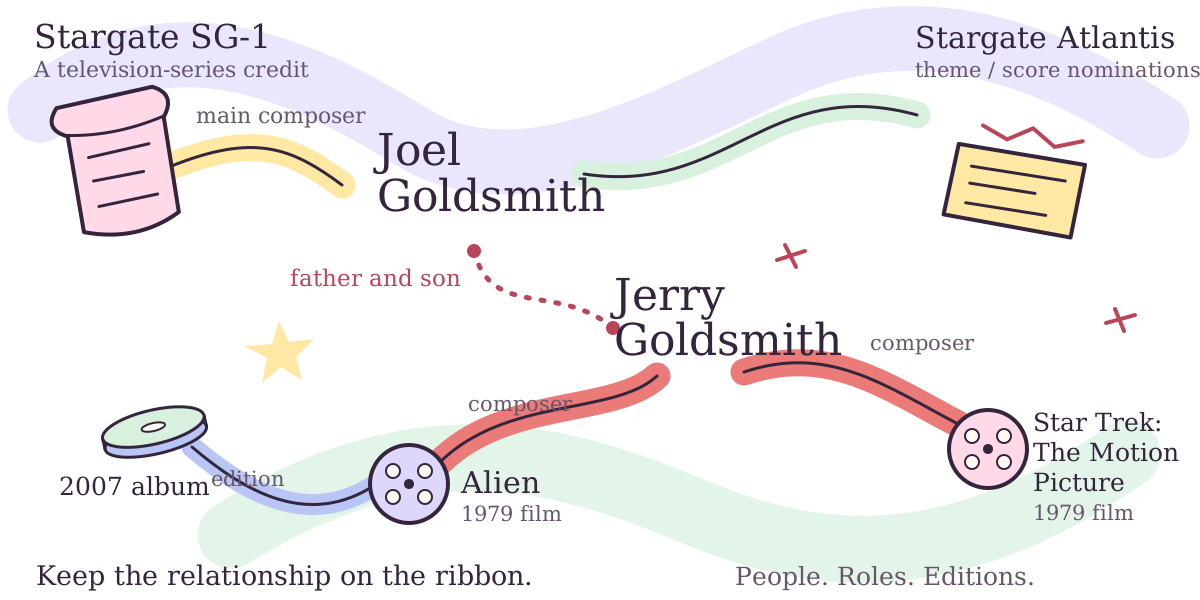
A credit can lead you into another world without asking you to finish the one you started. Begin with Stargate SG-1 and composer Joel Goldsmith. A documented family connection leads to Jerry Goldsmith; two specific film credits then offer a route to Alien and Star Trek: The Motion Picture, both released in 1979.
The interesting part is keeping each connection named. “Main composer,” “father and son,” “same credited composer” and “another album edition” describe different relationships. This is a small discovery trail with places to stop, rather than a complete filmography, a listening order or an argument that the fictional worlds connect.
A source warning before you follow: the soundtrack-label pages linked here include track names and synopses that reveal plot details. This article stays with credits and release identities. You can complete the exercise using the evidence summarized here, then open the original records when their spoiler boundary suits you.
Start with a name, then keep its scope
BMI’s 2012 remembrance identifies Joel Goldsmith as the main composer of the television series Stargate SG-1. That gives us a concrete starting point. It does not assign him every piece of music in the franchise, or even every cue in that one series.
There is a useful counterexample in Intrada’s Stargate SG-1 album description: Richard Band composed music for selected episodes across the first two seasons. Its 2017 release draws from those particular contributions. A familiar series title at the top of an album therefore needs the composer and selected-program scope beside it.
Before moving on, hold four details together: the person, the credited role, the exact screen work and the source or edition you are reading. “Goldsmith did Stargate” loses information that “BMI identifies Joel Goldsmith as SG-1’s main composer” preserves. The longer version also tells you where the next verification begins.
Follow the people: Joel → Jerry → two films
BMI explicitly identifies Jerry Goldsmith as Joel’s father. The family connection is documented; it is not a guess based on a shared surname. Keep their first names attached as you follow it. We are changing people at this junction, not extending Joel’s credit to work by Jerry.
From Jerry, choose either of two concrete destinations. Intrada’s Alien release credits his score for the 1979 film. La-La Land’s licensed Star Trek: The Motion Picture release credits him as composer and conductor of that 1979 film. That second title is one specific movie, rather than a claim about every Star Trek production.
The two films now share a verified composer connection in our trail. That fact alone says nothing about whether they use the same melody, whether one influenced the other or whether their stories belong together. You have found a person worth exploring across different projects; the more interesting creative questions remain open.
A comfortable exit: stop after identifying those two film credits. If one title interests you, pick that project next. Our Alien viewing guide can handle the order question separately; no marathon is required to make this connection useful.
Follow the role: a theme and a score are specific work
Stay with Joel instead and open the Television Academy record. It lists a 2005 main-title-theme nomination for Stargate Atlantis and a 2006 music-composition nomination for the series. These identify different categories of work. The dates are the award years, and both entries are nominations.
That distinction gives you a better next question than asking who “did the music.” Are you curious about an opening theme, the music accompanying a particular story or the people presenting a soundtrack album? Keep the object of curiosity visible before choosing a name to search.
Roles can also differ from project to project. The Alien label page names Lionel Newman as conductor, while the Star Trek: The Motion Picture release names Jerry as both composer and conductor. Read each record independently instead of carrying one project’s role across to another.
A comfortable exit: identify one role you want to learn about, then return to the Stargate hub. A theme credit can be your reason to choose a beginning; it need not become an unsupported claim about an entire series.
Follow the edition: the album is another object
Intrada’s Alien record supplies two dates: 1979 for the film and 2007 for this album release. Its contents distinguish the original score, alternate cues and the original 1979 soundtrack-album program. The later date belongs to the edition you are reading about; it does not turn the film into a 2007 production.
The distinction also prevents an easy leap from a track list to the finished movie. An expanded collection can document material beyond what a viewer hears in the film. Keep labels such as “alternate” attached to the relevant material rather than treating everything on a release as one interchangeable record of the final cut.
A comfortable exit: choose one clearly identified program or section of the release to investigate. Write its label beside the film title and composer. You can stop with a precise question about an edition, without deciding which version sounds best or making a comparison you have not actually heard.
Try the connection before carrying it further
Each observation below is supported by the linked records. Before opening its note, decide what the observation establishes and what would need another source.
Joel is SG-1’s main composer. Does that assign him every cue?
No. BMI establishes the main-composer role; Intrada identifies Richard Band’s selected early-season contributions. Keep the series-wide description and the particular contribution at their own scales. A specific episode or recording needs its own credits.
Joel and Jerry share a surname. Is the family connection an inference?
Here it is documented: BMI identifies Jerry as Joel’s father. That permits a family branch in the trail. It does not merge the two identities, show that they worked together on these selected projects or establish that their music has the same style.
Jerry is credited on Alien and The Motion Picture. Is that the same music?
The records establish the same composer on two distinct films. A claim of reused music, musical resemblance or creative influence would require evidence addressing that specific claim. The credit connection is useful without supplying an answer it does not contain.
The Alien album is dated 2007. Is that the film’s year?
No. The label separately dates the film to 1979 and this album to 2007. Keep the release object attached to its date, and retain the distinction between the score, album program and alternate material within the set.
Come back up with one good question
A worthwhile rabbit hole leaves you with something more precise than “everything is connected.” You might have found a composer’s next project, a different credited function or a release whose contents need closer reading. Choose one and leave the others available for another day.
Return to Rabbit Holes for a different discovery trail. If your question has shifted from screen music to awards, our Record of the Year vs. Song of the Year guide examines a separate distinction between a recording and a composition. Carry the habit of checking the role with you, while letting each source define its own work.