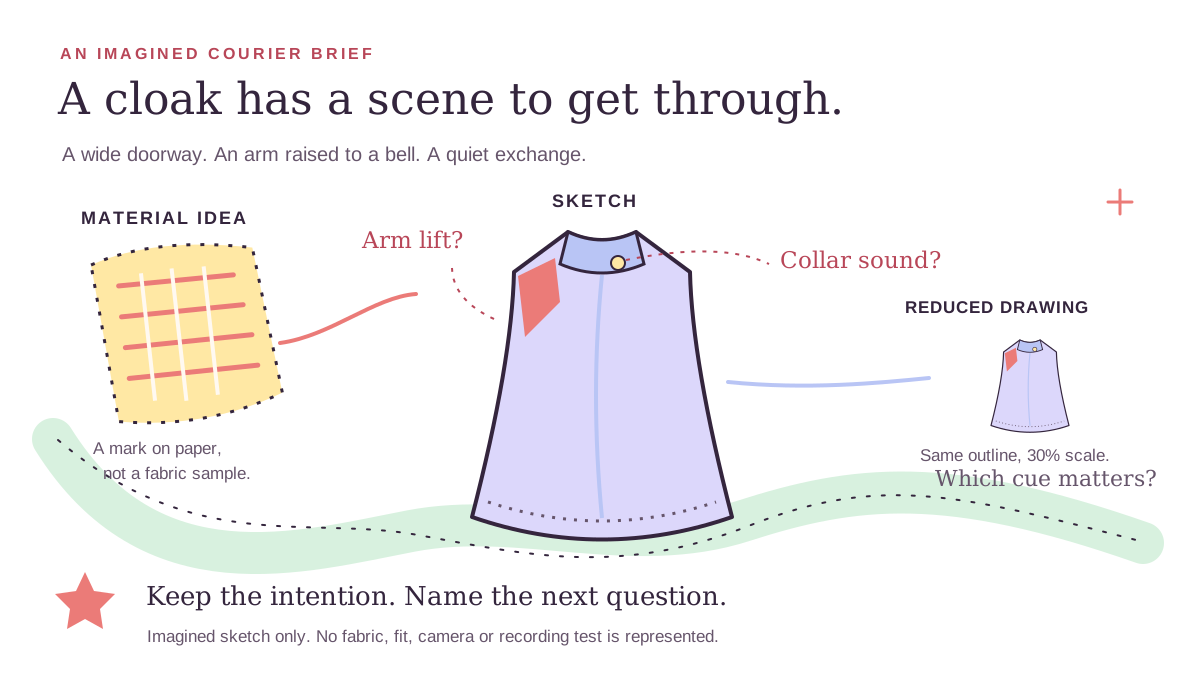
A TV costume has to connect a story idea with the demands of performing and recording it. A beautiful sketch can begin that conversation without answering every question. ScreenSkills describes costume design as script interpretation in collaboration with other departments; its professional checklist considers function, action requirements and coordination. Responsibilities vary with a production’s scale, budget and genre.
Amazon’s season-one Rings of Power costume interview records Kate Hawley’s process: fabric selection considered movement; reduced costume-and-hair photographs helped her inspect silhouettes; and checks addressed sound and visible finish or fit. These are her production’s reported processes, not our tests or a universal recipe.
This article avoids character outcomes. Amazon’s interview contains story-specific images and descriptions, so its external link goes beyond that boundary. Our example below is entirely invented.
Give the cloak a scene to get through
Imagine a courier introduced in a wide doorway. They raise an arm to ring a bell, then speak quietly in a closer shot. The brief asks for a recognizable shape without letting the clothing overwhelm the encounter. That is already more useful than “make a mysterious cloak”: it names an introduction, an action and a change in the scene’s emphasis.
Our illustration pairs a broad shoulder accent with a narrow decorative border and a small collar ornament. The smaller cloak repeats the same drawing at 30 percent scale. These are graphic choices, not fabric samples, a garment pattern or predictions of how a real camera would record clothing.
What should survive the smaller view?
Choose the cue you want the courier’s introduction to carry: the shoulder accent, the border or the overall outline. Then compare the two drawings. The useful question is whether your design intention depends on a small detail, or whether a larger shape could carry it.
There is a tradeoff. Enlarging an accent gives it more space in the drawing, but also changes the garment’s emphasis. Perhaps the courier should enter quietly; perhaps their shoulder mark needs immediate attention. The story brief helps you choose what to explore, rather than treating maximum visibility as the goal.
Does this prove which detail viewers would notice?
No. The smaller SVG is a drawing comparison. It does not measure attention, viewing distance, visual acuity, lighting or camera sampling. It helps formulate a question for the actual image, not certify an audience response.
What happens when the cloak has to move?
Return to the bell. A front sketch does not show what happens at the shoulder when an arm rises, how a fastening behaves or whether a garment fits a particular performer. Drawing a slit or shortening a hem is a proposal to examine, not evidence that the action will work.
Write the action beside the material idea: “raise an arm, then settle into conversation.” Now the intended shape and the physical question sit together. If you change the design, ask what you hoped to preserve as well as what problem you hoped to investigate. A change that answers one requirement can also change the character’s outline.
What is a useful next step, rather than guessing from the sketch?
Bring the action and intended look to the relevant costume, performer and production team for appropriate assessment. Our exercise cannot establish fit, clearance or safe movement. No material is being recommended as a universal solution.
What changes when the scene becomes quiet?
The collar ornament supplies a visual detail. During the imagined quiet exchange, it also gives us a question to raise with the costume and sound teams. We cannot hear the drawing. Its color says nothing reliable about how an actual object would sound against clothing or near a microphone.
Would removing the ornament settle the recording question?
It would change the design, but this sketch cannot establish the recording result. Actual movement, microphone arrangement and image conditions would need appropriate checks. Keep the question attached to the scene instead of declaring a fabric silent or a fix proven.
Keep the observation beside the interpretation
The exercise ends with better questions, not a winning costume. When you next watch a scene, try describing a visible shape or movement before saying what it suggests to you. A maker’s stated intention and your interpretation are different contributions to that conversation.
For another way into the world, visit our Lord of the Rings hub or Rings of Power entry guide. The Prime Video discovery routes connect this craft doorway with other viewing interests.