No: you do not need to watch the Lord of the Rings films or read Tolkien’s books before starting The Rings of Power. Amazon’s own guide explicitly answers that prerequisite question: the series is understandable for newcomers, while familiarity can add recognition. If the television series is what has made you curious, you can begin there.
That permission is different from declaring a universal best order. Our Lord of the Rings hub recommends the film trilogy for someone choosing a first film journey. This page answers a more specific question: whether that film route must become homework before a television invitation. It does not. You can choose the form you are interested in now.
This guide discusses setting, versions and ways into the world, without revealing character outcomes or season twists. Several source pages contain recaps and extensive lore; following them can reveal more than the limited claims linked here.
“Earlier” describes the setting, not your assignment list
Amazon places The Rings of Power in the Second Age, thousands of years before the events depicted in the Hobbit and Lord of the Rings film trilogies. That is useful orientation. It explains why a familiar world can appear at a different point in its history.
It does not follow that the earliest fictional setting is always the best first experience. An introduction and a chronology do different work. One asks how you would like to meet a world; the other asks how broadly described events relate in time. You can understand that distinction without calculating exact fictional years or arranging every adaptation into one enormous playlist.
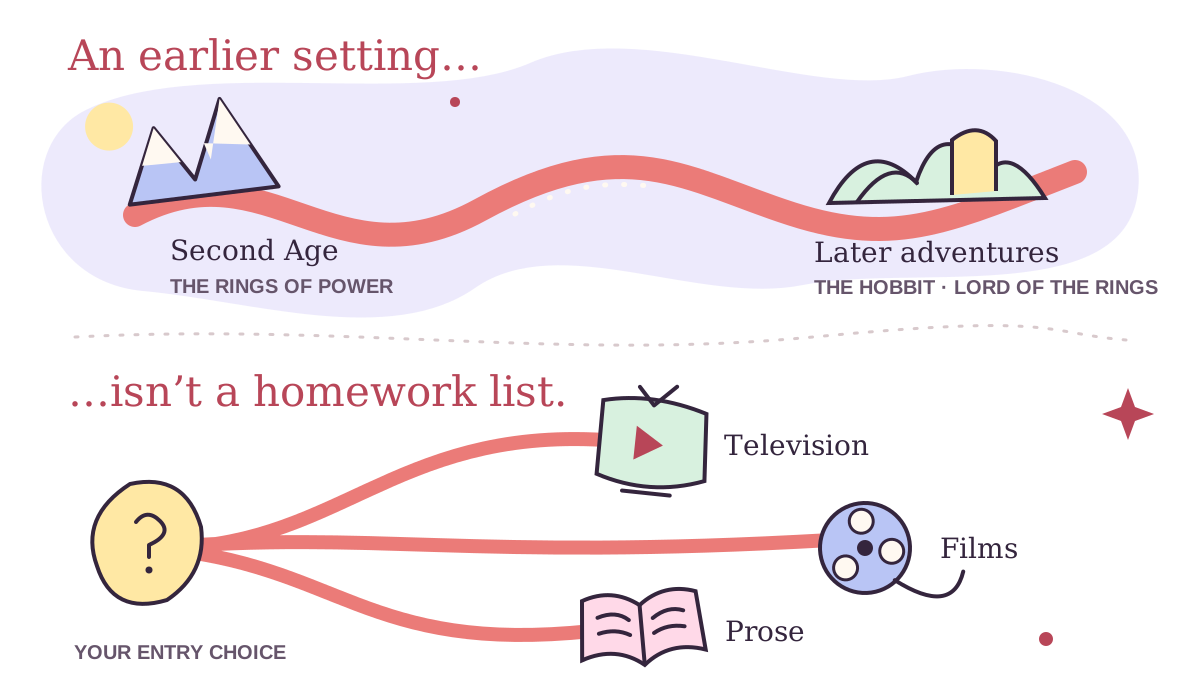
The illustration deliberately keeps two ribbons separate. The upper ribbon is a broad setting comparison: an earlier age and later adventures. The lower ribbon is a reader choice: television, films or prose. Its branches are invitations, not missing chapters. Decorative distance is not a measure of years, and the diagram does not assert that every screen version shares one continuous narrative.
Choose the experience that made you interested
I want to start a television series tonight.
Begin The Rings of Power at its first episode and follow its episode order. Amazon presents it as an entry for newcomers. Give its introductions room to work before opening a character wiki. If a name is unfamiliar, you do not need to solve its entire history before the next scene.
I want the Lord of the Rings films first.
Choose The Fellowship of the Ring, then The Two Towers and The Return of the King. Fathom’s official trilogy listing identifies that three-film sequence. This is a complete choice for your first film journey; you do not have to commit to every other Middle-earth production first. Use our hub for the next step.
I would rather meet Tolkien through the books.
Use the book route in our Lord of the Rings hub, which recommends The Hobbit before The Lord of the Rings. That is our reading recommendation. The Tolkien Estate explains the novel as one continuing work published in three volumes; reading it is its own experience, rather than an entrance exam for a screen adaptation.
The official trilogy listing supports the three film titles above; the Tolkien Estate supplies the prose distinction. The preferences are ours. There is a useful difference between “this is the sequence within the trilogy” and “everyone must finish the trilogy before enjoying another version.” Only the first is an instruction about that particular sequence.
Keep the version attached to the detail
As you explore, keep a small label beside a fact or impression: in this television series, in this film, or in this passage of the book. It is a more useful habit than treating every familiar name, image or event as a promise that another version must reproduce it in the same way.
This guide does not settle a film-versus-television canon argument or infer legal rights from a shared setting. Its narrower point is practical: the source for an earlier-setting claim does not, by itself, establish every relationship between adaptations. You can compare versions thoughtfully while letting each work introduce its own details.
If you choose the films and the immediate obstacle becomes theatrical versus extended, our edition guide handles that separate decision. A cut is a version of a film, rather than another era to insert into a chronology. Settle one question at a time and the world becomes easier to enter.
Try one visual question instead of a lore quiz
Here is a small exercise you can bring to the television route: what does a place tell you through how people work, travel and build? It gives you something concrete to notice before you know every family or kingdom.
There is a documented design example behind the question. In Amazon’s interview with production designer Ramsey Avery, he describes Númenor’s port through working activity, pulley technology and a distinctive use of shape and colour. Those are choices you can discuss as design, without turning recognition of older lore into the only way to appreciate a scene.
Our exercise is to pick one detail and make two notes: what is visibly there, and what impression it gives you. “There is a mechanism moving cargo” and “the place feels organised around trade” are different kinds of statement: an observation and an interpretation. Keep them distinct. You can return to a creator’s explanation afterward without assuming your first impression was a factual history lesson.
A starting point is separate from access
Knowing where to begin does not establish which current subscription, rental or purchase includes the exact item you want. US and Canadian readers should check their own local listing and signed-in offer. This guide uses source pages for identity and entry context, not as a promise that a historical catalogue description still matches either country’s current entitlements.
If the listing itself is confusing, use our Prime Video offer-reading lab. If you are ready to choose the next adventure, return to the Middle-earth hub. The useful route is the one that turns curiosity into a first chapter you actually want to experience.