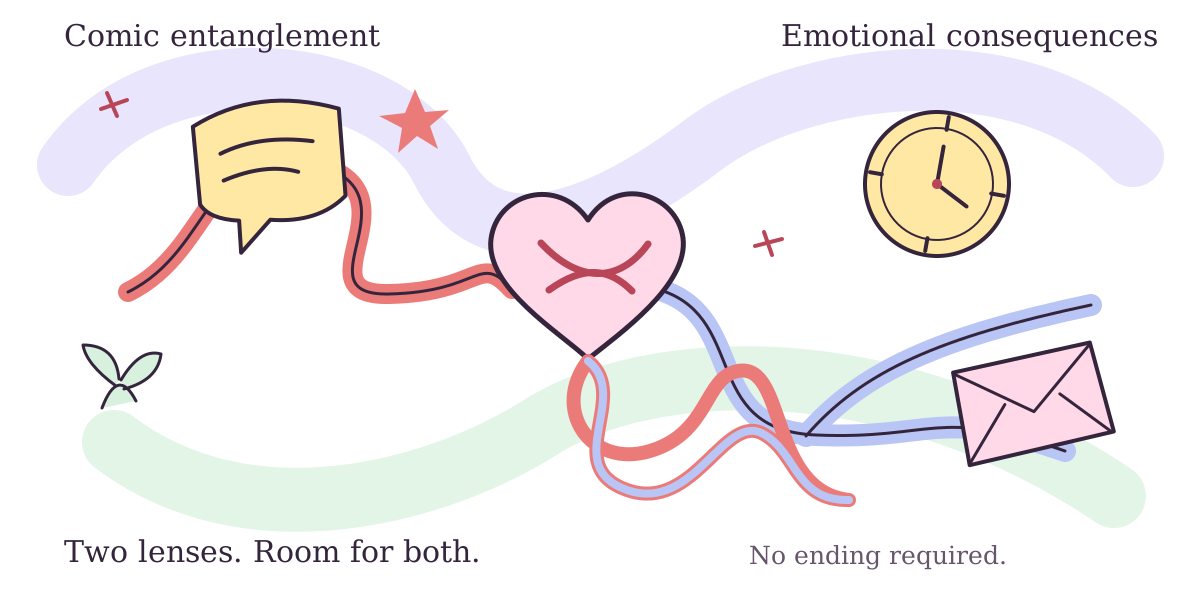
A useful starting distinction is what the romance repeatedly invites you to enjoy. A romantic comedy often turns attraction, concealment or incompatible plans into comic situations. A romantic drama gives greater weight to the relationship’s emotional consequences. These are overlapping ways of describing a story, rather than two sealed boxes.
You do not need to discover the ending to make that choice. A sad moment does not cancel a comedy, and a joke does not turn a drama into a romcom. Instead, look for the pattern of situations the premise sets in motion, the costs the characters face and the tone you want to spend time with. Our Romcoms hub offers starting routes; this guide helps you describe the mood you are looking for.
The named examples here stay at premise level. The three reunion scenes below are completely invented, with no connection to those films. We do not reveal or promise anyone’s romantic outcome.
A comic scheme gives the romance something to do
Netflix labels Set It Up (2018) as romantic comedy and describes two overworked assistants who try to make their bosses fall in love. Even before learning how that plan works out, you can identify an engine for comic situations: people are attempting to manage other people’s feelings for a practical advantage.
Our reading of the premise is that a scheme creates repeated opportunities for the planners to be surprised. The thing they can organize—a meeting, a schedule, an excuse—may be different from the thing they cannot control: another person’s response. That gap can keep generating new situations. You do not have to count jokes or assume that the characters lack serious needs.
For your own selection, look for an active comic mechanism in the synopsis. It might be a secret that gets harder to maintain, two incompatible plans that keep colliding or a performance that becomes difficult to sustain. A sentence saying that two people fall in love tells you less about the experience than a sentence explaining what keeps putting them in interesting situations.
A dramatic question can outgrow “will they get together?”
A24 describes Past Lives (2023) as a modern romance about childhood sweethearts reunited for one week after decades apart. We use a dramatic lens for that premise: the passage of time makes the encounter a question about lives already lived, as well as a possible connection in the present. That is our analysis, not a claim that A24’s page assigns an exclusive genre.
In her own 2023 note, writer-director Celine Song describes interests including first love, unrealized lives, different versions of the self and cities. Her account gives you more specific expectations than a generic promise that a film will be emotional. The romantic question intersects with identity and place; knowing that does not require knowing the resolution.
Song also explains in Le Cinéma Club’s published Q&A that character and story guided the visual choices she developed with cinematographer Shabier Kirchner. That is a useful craft question to carry into any romance: what does a scene’s arrangement let the characters express or withhold? A pause, a distance or a change of position can matter alongside the dialogue.
The same reunion can lean in three directions
Imagine two former neighbors, Ada and Remy, meeting again while organizing a community garden party. They once knew each other well. Now each has a different idea of what the reunion means. Keep that starting point and change the recurring problem.
Follow the elaborate plan that keeps becoming less manageable
Ada invents a reason to work beside Remy for the afternoon, but the volunteer rota keeps placing them on opposite tasks. Remy tries to fix the rota, unintentionally dismantling each new excuse. In this imagined comic version, both people’s efforts create the next complication. Ask whether you want that pleasure of escalating plans, awkward admissions and a situation that keeps changing shape.
Stay with a choice that cannot preserve every possibility
Remy has accepted a job in another city. Ada has just committed to caring for the garden through the next year. Neither obligation is a villain or a misunderstanding that one explanation can erase. This imagined dramatic version asks what each person is prepared to change, and what a meaningful choice might cost. It need not remove humor from their afternoon.
Let the awkwardness be funny and the decision still matter
They keep misreading each other’s enthusiasm for an absurdly ambitious party centerpiece. Their attempts to be helpful are funny; the conversation about Remy’s departure remains difficult. A mixed approach can enjoy the silliness without treating the practical loss as disposable. Ask whether both tones grow from the same people, rather than assuming that one must interrupt the other.
None of those descriptions settles the ending. Each gives you a different reason to follow the next scene. That is the distinction worth testing when a catalogue label feels too broad: what kind of attention is the story inviting, and is it the kind you want tonight?
A trailer is a selection of moments
In his BAFTA screenwriters’ lecture, Ol Parker recalls finding the especially sprightly trailer for The Best Exotic Marigold Hotel different from the melancholy-comedy tone of the film. His account is a specific example, not proof that every trailer is misleading. It does show why a collection of the funniest moments cannot, by itself, establish a whole film’s balance.
Use a short synopsis and a creator’s description together when available. The synopsis helps identify the continuing situation; a specific process account can reveal what the filmmaker wanted to explore. Keep promotional labels in context, and let a hybrid description remain a hybrid instead of forcing a verdict.
Choose a mood without outsourcing the surprise
Before choosing, finish one sentence: “Tonight I want to follow…” You might want people caught in increasingly inventive romantic complications, a relationship carrying difficult consequences, or a mixture that leaves room for both. That preference is more precise than demanding that every romance make you feel the same thing.
If a particular ending is essential for your evening, a genre label cannot settle it. Consult a clearly spoiler-labelled source deliberately, rather than treating this comparison as a guarantee. Likewise, check local content information separately from tone; a light premise does not establish suitability.
For a closer look at the opening spark, continue to our meet-cute essay. To notice how a conversation makes room for two perspectives, explore the shape of a film frame. Or return to the Romcoms hub and pick the kind of encounter you want to follow.