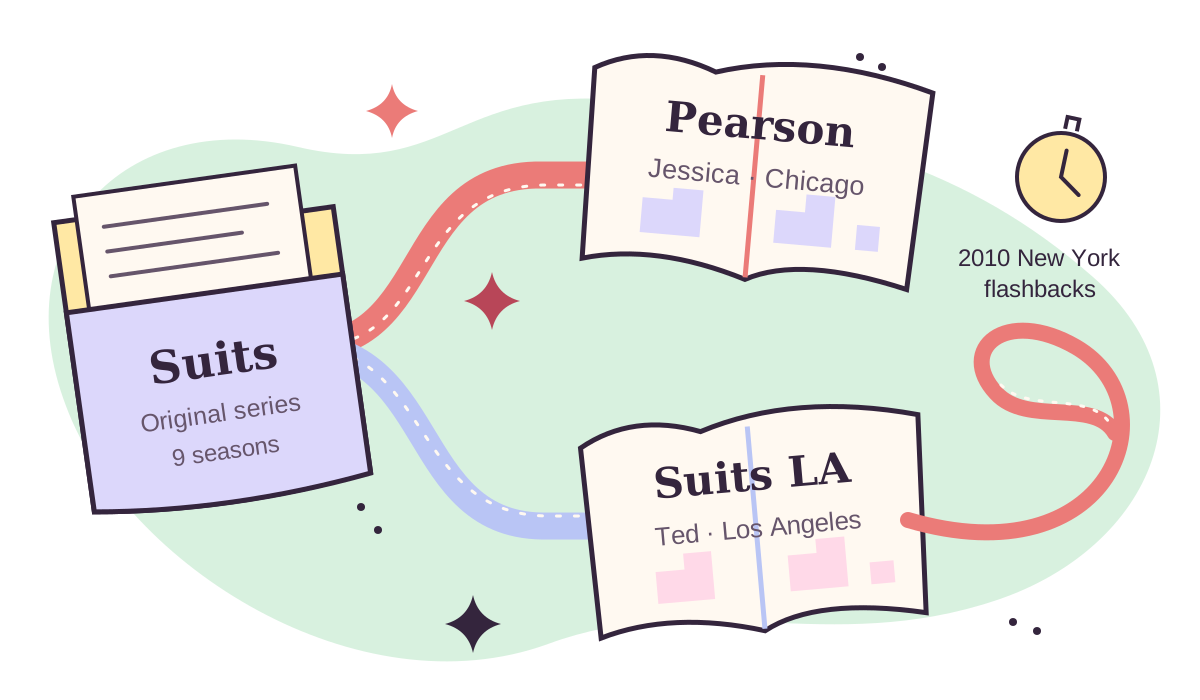
Suits LA is a separately titled spinoff with a new central ensemble, not simply season ten or a story set entirely before Suits. Its Los Angeles story also uses 2010 New York flashbacks. Pearson has a different connection: it follows Jessica Pearson into her own Chicago-centred story. Those distinctions are more useful than trying to squeeze every programme into one sequel-or-prequel box.
This guide explains the relationships between the titles. It reveals the broad settings, the Pearson handoff and an original-character guest connection, but no case outcomes or original-series finale resolutions. For the practical viewing routes, the Suits hub keeps the episode choices together.
A shared world can contain different kinds of continuation
The original Suits has nine seasons, according to USA Network’s Pearson feature. A separately titled spinoff can inherit a character, a shared fictional world or a creative approach without becoming another numbered season of that original.
For a reader, I would separate three questions: who is now at the centre, what prior history carries across, and when a particular scene takes place. The answers do not have to line up in the same way for every branch. A character can continue into another programme while that programme introduces people and problems of its own.
Pearson follows a person into another arena
USA’s account of Pearson identifies Jessica’s move into Chicago politics and locates the backdoor pilot in Suits season seven, episode sixteen, “Good-Bye.” In this case, the useful connection is a continuing central character, rather than a new actor replacing Jessica or an instruction to restart her history.
A backdoor pilot is an introduction to a possible separate series carried inside an existing programme. Here, that label identifies a handoff within Suits. It does not mean the numbered season suddenly becomes a different series, or that the new programme’s episodes should be counted as the next Suits season.
Release timing is another separate layer. USA dates Pearson’s premiere to 17 July 2019, during the original’s final-season period, and identifies ten episodes. A branch can launch while its parent is still being broadcast. That fact alone does not supply a precise fictional sequence for every scene across the two shows.
Suits LA changes the centre of attention
The US broadcaster’s development-era introduction and CTV’s official synopsis identify Ted Black: a former New York federal prosecutor now representing powerful clients in Los Angeles. That is the new programme’s organising premise. The title points to a related world; it does not promise another full season centred on the original pairing.
This matters when choosing a programme from a familiar-looking thumbnail. Recognising a guest face can make a connection interesting, but it does not identify the regular ensemble or the story you will spend most of your time following. Match the programme title and central character before interpreting the guest connection.
A flashback belongs inside the story using it
Bell Media’s feature with Stephen Amell explicitly describes two threads: present-day Los Angeles and 2010 New York. It also identifies Gabriel Macht appearing as Harvey Specter in a flashback. That is evidence of an earlier period within the LA programme, not evidence that all of Suits LA takes place in 2010.
The distinction is between the time represented by a scene and the shape of the whole programme. A prequel classification makes a larger claim about a work’s place before another story. One backward-looking thread cannot do all that work on its own. A familiar actor appearing as the same character also does not make the new programme a remake of the original.
For a first watch, my recommendation is to let the show reveal its past in its own episode order. Rearranging flashbacks into an earlier timeline may answer a later analytical question, but it changes when the viewer learns the information. You can understand a jump backwards without turning it into a new viewing requirement.
Keep the release clock beside the story clock
The US broadcaster identifies the original’s broadcast run as 2011–2019. The LA feature’s 2010 label is a fictional-period marker. Those are different kinds of dates. Subtracting one from another will not tell you which episode to watch next or how a guest appearance is meant to land.
When keeping a viewing note, write the programme and episode first, then note “flashback” only if you need to distinguish that scene. For example, “Suits LA / current episode / 2010 New York thread” is clearer than calling the whole show “the prequel.” It preserves the information without pretending to map every event in the franchise.
Check the connection you actually care about
I saw Harvey in an earlier-looking scene. Should I start there?
Identify the programme and whether the scene is in its flashback thread. The broadcaster’s LA feature describes Harvey appearing in a 2010 flashback. For a first visit, follow that programme’s episode sequence rather than treating the clip as a newly discovered opening episode of the original.
I want to follow Jessica. What does the handoff mean?
“Good-Bye,” Suits season seven, episode sixteen, is the broadcaster-identified backdoor pilot. Pearson is the separate Jessica-centred branch. Use the hub’s Jessica route to choose a convenient handoff; the branch point is not a demand to interleave every subsequent episode.
A guide calls the LA show a reboot or remake.
Ask what the guide means by that word. The official premise centres Ted Black, while the shared-world connection can bring back an existing character. A loose promotional label should not replace the more useful questions of central character, story continuity and scene chronology.
Return to the Suits viewing routes to choose a starting commitment. To think further about how a series reveals an ongoing story, visit our television structure guide or the watch-order decision guide.