The 180-degree rule keeps camera setups on one side of an imaginary action line. In a two-person conversation, draw that line between the people. Staying on one side helps preserve their left–right relationship across cuts, even when each person appears in a separate close-up. Columbia’s Film Language Glossary.
Follow the looks across the cut
Our invented café scene holds Ari and Bea in fixed seats. Ari looks toward Bea; Bea looks toward Ari. The floor plan shows the camera positions, while the portraits show the resulting screen directions. “Upper” and “lower” mean opposite sides of the floor plan, rather than camera height.
One conversation, four viewpoints
The original scene stays fixed: A is Ari, in coral; B is Bea, in mint. The letters and different hair shapes identify them as well as the colours. Follow the camera arrows in each overhead plan, then compare the profiles and their gaze arrows. All four arrangements are shown to start.
All four comparisons are shown. The people stay still; only the viewpoints change.
See the room
Overhead plan
Screen view
What changes? Start with both people in one picture. Ari occupies screen-left and looks right; Bea occupies screen-right and looks left. The plan is the room seen from above; the drawing beside it is the camera’s view.
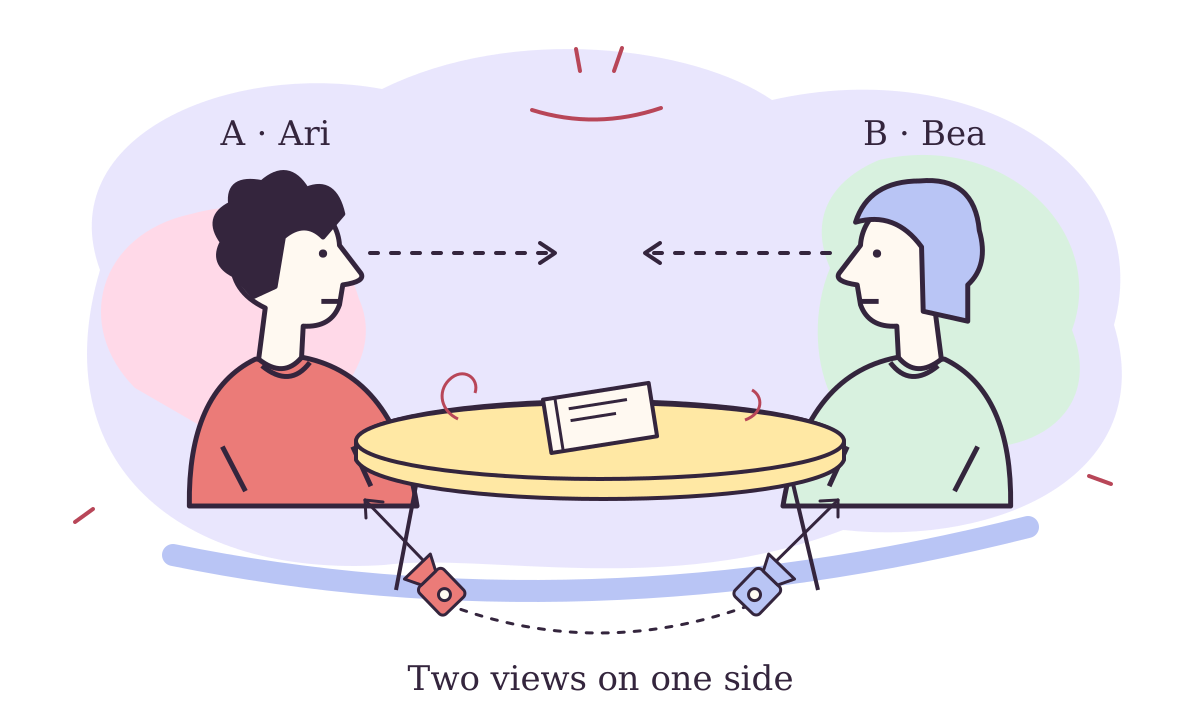
Two views, one side
Overhead plan
Screen views
What changes? Two separate portraits keep opposing looks: Ari faces screen-right; Bea faces screen-left. The cameras aim in different directions while remaining on the same side of the action line.
Cross one reverse
Overhead plan
Screen views
What changes? Both portraits now face screen-right. Ari and Bea still look toward each other in the room; only Bea’s viewpoint changed. This compares an apparent facing change, without grading it as an error or predicting a viewer’s reaction.
Another side, another pair
Overhead plan
Screen views
What changes? Ari now faces screen-left and Bea screen-right: another pair of opposing looks. The wide reference reverses their image positions. This is a separate comparison, not proof that jumping between sides mid-scene would be unnoticeable.
Why does the profile change when the person stays still?
Ari’s world-facing direction stays toward Bea, and Bea’s stays toward Ari. A different camera has a different screen-right direction. Projecting the same look onto that direction can therefore reverse its left/right sign. Our lower-side wide places Ari left and Bea right; the upper-side wide places Bea left and Ari right.
The portraits use that same directional calculation. They are simplified profiles, not a perspective rendering, a crop of the wide drawing or a simulation of any lens. Camera symbols show where each view originates and what it aims at; they are not people moving through a filmed scene.
Original hypothetical scene and geometric comparison by Dream Daley. This lab changes camera positions while keeping the people fixed. It does not demonstrate a complete edited sequence or predict an audience’s response.
A reverse angle can stay on the same side
In “Two views, one side,” both cameras are below the action line. Ari looks screen-right; Bea looks screen-left. The camera changes subjects without crossing the line, so the opposing looks remain consistent.
In “Cross one reverse,” only Bea’s camera crosses. Bea remains in the same chair, looking toward Ari in the room, but now both portraits face screen-right. The camera move has changed the screen relationship without moving the people.
Adobe’s dialogue guide explains this same-side use of reverse angles. A reverse angle means showing the other direction of a conversation; it need not mean putting the camera across the action axis.
The opposite side can form another consistent pair
When both cameras are above the line, Ari looks screen-left and Bea screen-right. Their screen positions reverse together. This is another internally consistent arrangement, but cutting abruptly between the two arrangements still reverses the established relationship.
Columbia also discusses filmmakers deliberately crossing the line. A real scene can supply movement or other spatial context that these static drawings omit. A reversal is a visible choice to examine, rather than automatic proof of an editing error.
To compare the space inside one picture, try the aspect-ratio lab. To see how cuts control knowledge rather than geography, read suspense versus jump scares.